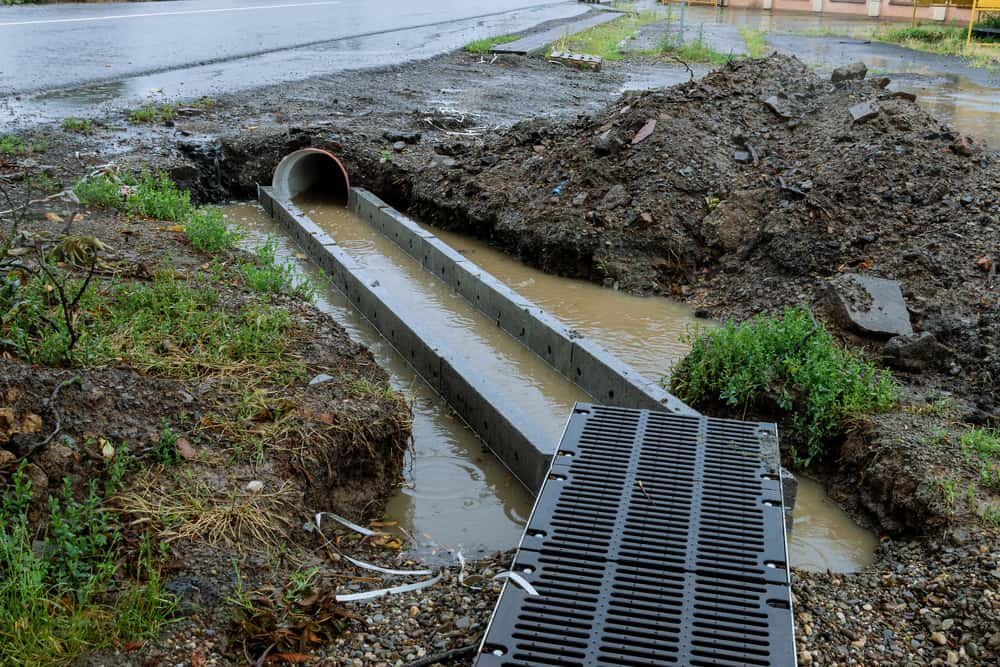
Storm Drain Installation for Commercial Sites in Las Cruces
Nine inches of rain a year sounds harmless. Las Cruces averages 9.14 inches of annual precipitation, and the surrounding arroyos are dry streams that often carry water after heavy thunderstorms. The average hides the real design problem, which is that most of that rain arrives in short bursts that turn a parking lot into a river in minutes. Storm drain work in this metro has to be sized, built and graded for the burst, not the yearly total.
We install storm drain systems for commercial and industrial sites, including inlets, pipe, junction structures, headwalls and outfalls. We build them alongside the paving and the building pad, because a drain that is a few inches off grade can leave a pond in a drive aisle for a day after every storm. The rest of this page explains how we sequence storm work, what we watch for in the valley and where the cost comes from.
Why storm systems matter more here than the rainfall number suggests
Large flat sites collect water. Think of the Dona Ana County International Jetport, a county-owned airport with one 9,550 by 100 foot runway on about 170 acres. A paved area of that scale sheds a lot of water in a short time, and the same principle applies on warehouse yards, truck courts and big-box lots across the metro. Where roofs and pavement replace desert ground that used to absorb runoff, the storm system has to carry what the soil no longer takes.
Sunland Park gives another view. The city sits next to the Rio Grande at the foot of Mount Cristo Rey at 3,740 feet, and sites between the mountain and the river have to deal with runoff coming off the slope as well as rain falling on the lot. We look at the drainage path from top to bottom before settling on pipe layout, because the water arriving from upstream is often the larger problem.
Arroyos, outfalls and the path water actually takes
Every storm system ends somewhere, and where it ends is usually the hardest part. An outfall can discharge to a detention basin, a channel, an arroyo or a public system, and each has its own approval and construction demands. Where water meets an arroyo, we protect against scour with the energy dissipation shown on the plans. Our page on culverts and headwalls covers crossings and endwalls in more depth.
Sediment is the other consideration. A new storm system that fills with construction silt in its first thunderstorm does not perform and may not pass inspection. We install inlet protection and keep the system clean until the site is stabilized, and we coordinate with the team handling erosion control and SWPPP so the controls and the pipe do not work against each other.
Pipe, inlets and structures
A typical scope includes trench excavation, bedding, reinforced concrete or other specified pipe, curb inlets, grate inlets, area drains, junction boxes, cleanouts and connections to existing systems. Each inlet is set to the grade of the gutter or pavement above it, which means the finish elevation must be coordinated with the paving crew. We work with curb and gutter forming crews so inlet throats and flowlines match.
Precast structures are set on a prepared base with the right sealant at the joints. We check rim elevations before the final lift of paving and adjust them as the plan allows. Where the plans call for cast-in-place structures, we form and pour them to the same standard, and we cover that scope under manholes, vaults and structures.
What moves the price of a storm system
Pipe size and depth lead the list. Storm lines tend to be larger than sanitary lines, so they require more excavation, bigger shoring and heavier equipment. The count of structures matters too: each inlet or junction box adds excavation, base preparation, setting and backfill. Long runs to a distant outfall can cost more than the on-site pipe combined.
Surface restoration is a quiet cost. If the storm line crosses an existing street or driveway, saw-cutting, trenching, backfill and repaving can be a large share of the line item. We price the surface restoration separately from the pipe so you can compare options, such as an alternate alignment that avoids a crossing. Where a developer is building a retail center or a shopping center with a large lot, early drainage planning can save money by reducing the number of crossings.
Building to grade and keeping the site dry
The grade is the product. We stake the system, verify inverts with a laser, and check every inlet and manhole against the survey before backfill. Pipe is bedded and joints are sealed according to the specification, with gasketed joints where the plans require watertight performance. Backfill is compacted in lifts, with extra care where the line will run beneath paving.
During construction, we protect open trenches from storm runoff by diverting surface water and staging materials out of flow paths. When a summer thunderstorm is in the forecast, we close the trench and tie off the open end. For commercial developers, we also provide a clear as-built record so the engineer can certify that the system was built as designed.
How storm drain work ties to ponds and paving
Storm drains rarely stand alone. They lead to detention and retention ponds, they pass under drives and parking fields, and they depend on pavement grades that someone else is finishing. We coordinate with the paving crew early, since a late change in a flowline can force the pipe to be relaid.
On parking lots, the order of work is pipe, structures, base, curb and then paving. If the pavement is concrete, the joint layout has to land on the inlets in a way that avoids awkward cuts, which is the sort of detail we work out on the shop drawing. Our experience with parking lot concrete helps us design that layout from both sides.
Bring us the drainage plan
Send the grading and drainage plan and tell us where the water goes. We will review inlet locations, pipe sizes and outfall conditions, and give you a schedule and price you can plan around. Projects near Sunland Park and the Dona Ana County Jetport are a good fit for this kind of early review.
Questions Owners Ask
How do you size a storm drain for desert thunderstorms?
Sizing is the engineer's job, based on a design storm, the contributing area and local drainage criteria. Our job is to build exactly what the drawings show and to alert the engineer if the field conditions differ from the survey. We also tell owners when we see something that looks undersized, such as a low point with no inlet.
Can a storm drain be installed after the paving?
It can, but it is more expensive, because you have to cut and repave. The better sequence is pipe first, then base and paving. If a change comes up late, we try to find a route that avoids cutting new pavement.
Who inspects storm drain work?
The owner's engineer, the city or county and sometimes a third party, depending on the project and the jurisdiction. They typically inspect bedding, pipe installation, structures and backfill. We schedule each inspection in advance and keep a log.
What can go wrong with a storm drain during construction?
Sediment loading, flotation of empty pipe in a flooded trench, and damage to inlets from heavy equipment are the common ones. We protect the system while it is under construction and clean any accumulated debris before final inspection.
Do you work on arroyo crossings?
Yes. A crossing needs a pipe or box sized for the flow, a bed that resists scour and protection at both ends. We build to the plan and work with the design team to confirm that the crossing performs as intended. See the discussion of culverts on our other pages for details.