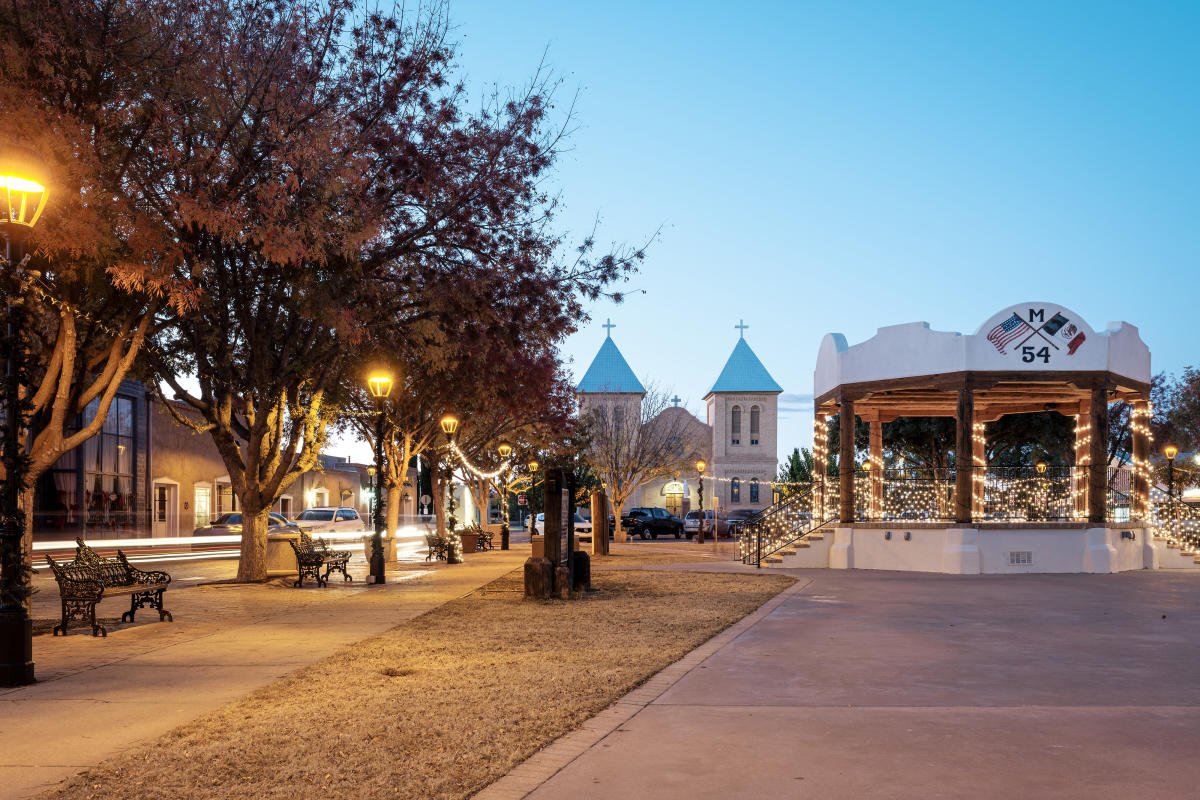
Historic District Concrete and Utility Work in Mesilla, New Mexico
Short pours, tight access and neighbors who can see everything we do: that is what concrete and utility work in Mesilla looks like. The La Mesilla Historic District, which includes Mesilla Plaza, was declared a National Historic Landmark in 1961, and a town built around a place like that expects a contractor to show up with small equipment, clean sites and a plan for keeping shops, restaurants and visitors moving while the work goes on.
Most of what we do here is not new construction on an empty lot. It is replacing a failed sidewalk, cutting a trench through an existing street to tie into a line, repairing a slab in a restaurant kitchen, or building an accessible entry into an older building. Those jobs depend on careful cutting, patching that matches what is already there, and a pour schedule that respects business hours. We price them for what they are, which is detail-heavy and low in yardage, and we tell the owner plainly when a repair makes more sense than a replacement.
New Mexico State Road 28 passes through downtown Mesilla as Avenida de Mesilla before turning northeast toward Las Cruces. It is a two-lane state highway, so equipment staging and lane closures need to be thought through early. We map the delivery path for ready-mix trucks, find a place to stage a pump, and talk to adjacent owners about when the street will be affected.
Working inside an older, busy town center
We start with a walk of the whole block, including the back alleys and the neighboring doors, and then write a short plan: where trucks stop, where materials sit, how people get around the work, and when each noisy step happens. Handing that plan to the building owner, the tenants and any town staff avoids most of the complaints that come from the unexpected.
Where a job calls for matching existing finishes, we make a sample panel before the full pour, so the owner can approve color, texture and joint pattern. For brick-look or scored finishes, our decorative and stamped concrete work uses the same discipline: a test area first, then the production pour, with the same supervision on both.
Approvals, reviews and cutting into old pavement
Because the town center is a designated historic district, we ask the town up front what design review or permit steps apply to a given scope, and we do not assume. Commercial work in New Mexico is permitted under the 2021 New Mexico Commercial Building Code (14.7.2 NMAC), which adopts the 2021 International Building Code as amended and took effect July 14, 2023, and renovations may also involve the state's existing-building rules. We have the design team confirm which governs.
Whenever we open pavement, we first locate what is underneath. A utility locate, a potholing crew and a pre-construction photo set protect everyone. We follow with clean, straight cuts using concrete sawing, cutting and coring equipment, which keeps patches tidy and reduces edge cracking.
Sidewalks, patches and entries around the plaza
The scope list here is practical: sidewalk replacement, curb ramps, entry slabs, patio and courtyard pours, trench patches, small equipment pads and the occasional footing for a new wall or addition. Many of these are done in sections so that a business can stay open. We use fast-setting mixes only where the schedule demands them and prefer a standard mix with good curing where it does not.
Existing concrete often needs repair rather than replacement. Our concrete repair and restoration approach is to find out why the concrete failed first, whether from drainage, subgrade, reinforcement or a bad mix, then correct that cause before patching. Patching over an unresolved cause just repeats the crack.
Visitors, delivery trucks and a live street
Pedestrians are the main hazard in a visitor district. We fence work areas, mark detours, keep walkways clear and accessible, and make sure no one has to step into the roadway to get around us. At the end of the day, steel plates cover open trenches that must stay open, and cones and lighting go out before we leave.
Dust and noise are the other concern. We wet-cut where we can, sweep daily, and run loud equipment at times the neighbors have agreed to. Hospitality owners such as hotel and inn operators value that kind of attention, because their guests notice it.
Why small jobs cost more per yard
A short sidewalk replacement in a historic district costs more per yard of concrete than a warehouse floor, and the reasons are simple: minimum delivery charges on small loads, hand placement, extra protection, sawing and haul-off of old material, and the time spent working around people. We show those items as separate lines in the proposal so you can see what is driving the price.
Owners who are commercial developers or property managers working in more than one place can often bundle projects. Combining Mesilla work with jobs in La Mesa or Chamberino along the same state road spreads mobilization costs and reduces the number of small-load charges.
Talk through your Mesilla project
Tell us the address, the scope and the hours the business is open. We will visit, walk the block and send a plan with a price.
Questions Owners Ask
Can you keep a restaurant open during a slab or sidewalk replacement?
Usually, yes, if we split the work in sections and give the owner a day-by-day plan. We pour entries early or late, protect access, and use temporary ramps where needed. We cannot pour while customers are walking over the area, so timing is the main conversation.
How do you match old concrete in a historic setting?
We start by studying the existing surface, then build a small test panel with the same mix color, texture and joint pattern. The owner and the town reviewer, if there is one, approve it before we place the full pour. Matching takes time, so we build it into the schedule.
What if we find unknown lines when we cut the street?
We locate and pothole before cutting, but old towns can still surprise a crew. If something unmarked appears, we stop, protect it, document it with photos, and contact the owner and the design team. The cost and the fix depend on what the line is.
Do you work on a plaza-area building that has an irregular floor?
Yes. We survey the floor, decide whether to grind, patch, level with a topping or replace sections, and explain the options and costs. In older buildings, matching floor heights at doorways is a common detail.
Can a ready-mix truck even reach the back of a plaza-area lot?
Often not, which is why we plan for a pump. A boom or line pump lets the truck stay on the street or in a wide spot while concrete travels to the back of the property. We check overhead wires, alley width and the pump footprint during the site walk and price the pump as its own line.