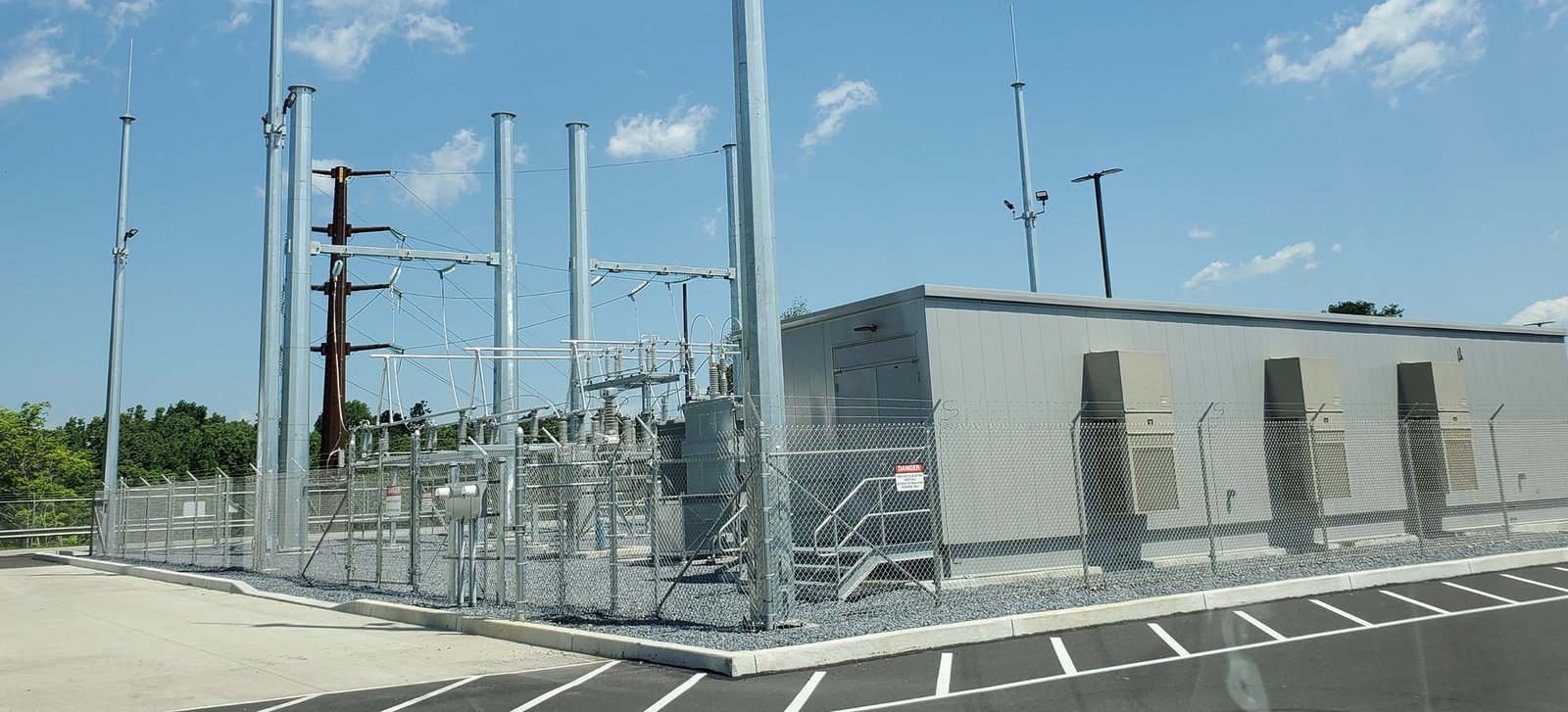
Concrete and Site Work for Utilities and Energy Companies in Dona Ana County
Easements, not parcels, define the work for a utility or energy company. Your crew thinks in corridors: a duct bank that runs along a road shoulder for a mile, a fiber route that crosses an irrigation lateral, a pad-mount transformer that has to be set before a customer's meter date. Our job is to trench, pour and restore along that line without dropping the schedule or surprising a landowner.
The Mesilla Valley adds its own geography. NM 28 is a two-lane, 30.346 mile state highway that runs roughly parallel to the Rio Grande, and the valley's farm roads, canals and ditches cross every route that matters. The Leasburg Dam, completed in 1908, diverts river water into canals serving valley farms, so crossings often involve an irrigation district as well as a road authority. And the load is growing: an August 2026 newspaper report described Project Jupiter as a 1,400 acre data center under construction in Santa Teresa, the kind of site that pulls substation and feeder work with it.
We install concrete-encased duct banks, conduit and fiber, transformer and switchgear pads, vaults and manholes, and the utility crossings that keep a project moving. Below is how that work gets planned and delivered in our part of New Mexico.
Where the lines are going in southern Dona Ana County
Growth in the region follows the interstates. Interstate 10 offers exits at NM 28 (exit 140), NM 478 and Main Street (exit 142) and I-25 (exit 144), and those corridors carry water, power and fiber as well as trucks. North along I-25, Rincon lies roughly 20 miles from Spaceport America, where construction created about 800 temporary jobs; that kind of remote, large-load project needs long feeders and its own site utilities.
Nearer Las Cruces, the airport's east side had utilities, lighting and taxiways extended in 2021 to support hangar development. A utility looking at a corridor like that should expect heavy coordination: airport operations, private tenants and public agencies all control some part of the ground. We make our own part clear by delivering a drawn duct layout, a survey of every pull box and a short list of conflicts before the first cut.
What we build for utilities and energy owners
Our scope for electric and communications owners centers on electrical duct banks: trench, spacers, conduit, concrete encasement, color marking and backfill, with pull boxes and handholes at specified intervals. We set transformer pads, switchgear pads and meter bases, and we pour equipment slabs with the embeds and conduit stub-ups the electrical contractor needs. New Mexico's 2020 Electrical Code, which adopts the 2020 National Electrical Code as amended, applies on the electrical side, and our job is to hand over a raceway system that meets the engineer's details and passes inspection.
For communications, our conduit and fiber trenching runs along roads and across fields, with bores or open cuts at crossings as the owner allows. In-ground structures, including manholes and vaults, come out of forms in our shop or are cast in place, and we set them to grade with the correct bedding.
Relocations, restoration and the work around the line
Most utility projects include more than the new line. Existing facilities may have to be moved, so utility relocation work sits alongside the new build, and we plan outages with the owner so customers lose service for as short a time as possible. Wherever we cut pavement, we restore to the road authority's standard, and where we cross a field we restore the surface and leave drainage as we found it.
Large energy loads also generate building work. The first phase of a data center tends to be pads, trenching and underground duct, long before servers arrive. We support those phases with the same coordination as other utility jobs.
Digging near energized lines and live gas
Working near energized electrical equipment or buried pressurized lines is the highest-risk part of the job. We call for locates, expose lines by potholing where needed, and keep clearance distances from overhead lines when we operate excavators or pump booms. If a locate is incomplete or a line turns up unmarked, we stop and call the owner before any further digging.
We follow each utility's safe-work rules and we attend site safety orientation before mobilizing. Trenches are protected with sloping, shoring or boxes under the federal excavation standard, and open trenches are plated or fenced at night. Any work that crosses a road gets a traffic control plan approved by the road authority before we start.
Outage windows, irrigation seasons and monsoon weeks
Utility schedules are built around outage windows, easement agreements and seasons. Irrigation canals carry water during the growing season, so crossings are often planned for periods when ditches are dry, and we confirm the dates with the district. Monsoon storms bring sudden flows in dry arroyos, so we plan the open trench length to what we can close the same day.
When the contract allows, we like to stage materials near the route, pre-assemble duct sections and pour pads ahead of the trench crew. That way a transformer can be set the week the energy owner wants it, not the week after a pad cures.
Cost drivers on long linear jobs
On linear utility work, cost follows trench length, depth, soil and what is on top of the trench. Pavement cuts and restoration costs more than field routes, bores cost more than open cuts per foot but save restoration, and rock or cemented soil can slow a trencher dramatically. We ask for geotechnical data along the route when it exists and we price unforeseen hard ground as a separate unit.
Concrete encasement is the other major variable. The amount of concrete per foot depends on the duct count and the standard detail, so we confirm the detail before pricing. For owners who share corridors with municipal and public works departments, and for those whose lines cross farms served by agriculture and dairy operations, we include landowner coordination and crop or ditch restoration in the price so nothing is left open.
Send us the route
Share the alignment, the duct count and your outage windows. We will return a unit-priced proposal with crossing methods and restoration standards stated up front.
Questions Owners Ask
Can you install duct banks in advance of the equipment that will feed them?
Yes. We often install duct banks, pull boxes and equipment pads ahead of the electrical gear, then hand the raceway system to the electrical contractor with proof of spacing, cover and mandrel testing. Leaving the conduits capped and labeled means the next crew can pull wire without searching for ends.
How do you cross an irrigation ditch or canal?
We confirm the crossing method with the irrigation district first. Bores or jacked sleeves are common under live canals, and open cuts are scheduled for dry periods with temporary flow control when the district allows. Either way, the ditch grade and lining are restored.
What do you do if potholing finds an unmarked line?
We stop work at that spot, document the depth and orientation with photos and survey, and notify the owner and the engineer. Then we review options, such as shifting the alignment or boring under the obstacle, before anything is cut.
Do you coordinate with the road authority for shoulder or crossing work?
Yes. We prepare traffic control plans and apply for the encroachment or right-of-way permit as the agency requires, and we stage equipment off the travel lane. Crossings of state roads typically take the longest to approve, so we start those submittals early.
How much open trench do you leave overnight?
As little as possible. We size daily production to what can be laid, backfilled and compacted by day's end. Where an open trench cannot be avoided, we plate or fence it and add lighting.