Utility Relocation for Road, Building and Site Projects in Las Cruces
Somebody else's pipe is in your way, and it is live. That is the whole problem with utility relocation, and it is why the work is more about coordination than about digging. The line belongs to a utility or a municipality, the customers it serves cannot go without, and the new building, road or pad has a date. We get all three on the same page before a machine moves.
Relocations come with growth. Interstate 25 begins at I-10 Exit 144 just south of the NMSU campus in a tri-stack directional interchange, and the roads, ramps and frontage around that kind of junction carry utilities that were laid for a much smaller city. Downtown Las Cruces is an older case: the first train arrived in 1881, BNSF freight service still runs through town, and a stretch of Main Street became a pedestrian mall in 1973 before a portion reopened to vehicle traffic in 2012. Older corridors mean older pipe in less certain locations.
Our relocation work covers water, sewer, storm, power, communication and gas coordination, and we run it as a project with a plan, not a series of surprises.
What makes a relocation different from new pipe
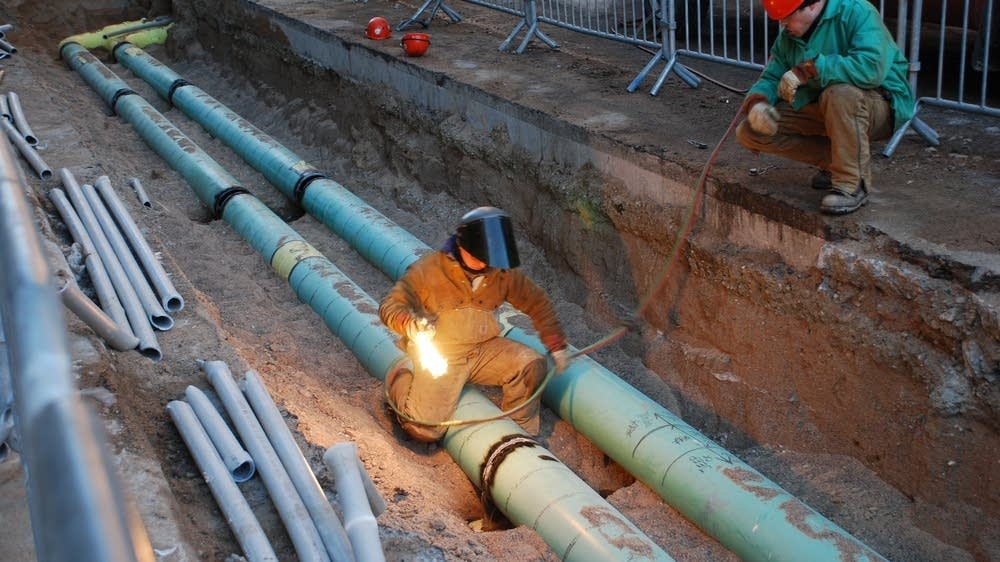
New pipe goes into clean ground. A relocation goes into a corridor already full of other lines, with a live service that has to be moved from the old alignment to the new one. The sequence matters: build the new line first, test it, tie it in with a short shutdown, then abandon or remove the old line. If the new line cannot be built beside the old one, we may need a temporary bypass.
The unknowns are the main risk. As-built drawings for older lines can be wrong, incomplete or missing. We pothole to verify depth, size and material before the design is finalized, and we use potholing and locating early so the engineer works from real data. Abandoned pipe left in the ground is another surprise, so we note it and decide with the owner whether to cap, fill or remove it.
How we move a line without losing service
We begin with a shutdown plan. Which customers are affected, for how long, and at what time of day? For a water line, a short outage in the early morning may be acceptable; for a hospital or a plant, we plan a bypass. The owner or utility issues notices, and the project trade crew arrives with all materials staged, fittings tested and a tie-in sequence rehearsed. We have one goal on the day of the shutdown: finish quickly and safely.
Once the new line is in service, we remove or abandon the old one as directed. Abandonment by filling with grout or flowable fill avoids future settlement; removal is cleaner but costs more. We also record the new location carefully, with survey points at bends and tie-ins, so the next contractor does not meet the same uncertainty. The record drawings go to both the owner and the utility.
Utility owners, permits and the right to dig
Each utility owner has its own process. Public water and sewer systems usually require plan review and a permit for relocation, and power and communication companies typically perform or approve the work on their own facilities. Gas utilities often do their own relocation in the field. We work with each owner under its own rules, and we identify early which parts of the work we may perform and which must be done by the utility.
A relocation in a public right-of-way needs a permit, traffic control and sometimes a flagger. On roadway projects, the relocation often has to be completed before the road contractor mobilizes. Our work on site utilities gives us a head start, since we know how the relocated line will be used. For projects on state highways or rail-adjacent corridors, additional approvals may apply, and we help owners find out early.
Getting the relocation done before the critical path needs it
Relocations tend to be on the critical path whether anyone planned for it or not. If the building pad cannot be graded until the sewer is moved, the pad waits. We ask the general contractor and the owner for the date the cleared corridor is needed, then work backward through procurement, permits and utility coordination. Long-lead items, such as large valves, special fittings and transformer pads, are ordered early.
Utility owners have their own backlogs. A crew from the electric company may need weeks of notice, and a shutdown on a major main may only be allowed during certain months. We build those lead times into the schedule and keep a written log of every request and response, which helps if there is a delay and someone asks why.
Who relies on relocation work
Municipal and public works owners need relocations for street projects, intersection upgrades and drainage work. Utilities and energy companies need them when they renew or reroute their own systems, and oil, gas and midstream operators need them when facilities change and lines must be moved around new equipment.
Private developers run into relocations when a site plan collides with an easement. We help them work with the utility to move the line or revise the plan, whichever is cheaper. If the project is a government building, the work often sits on the owner's schedule, which we describe in our notes on government and municipal buildings. Projects near downtown Las Cruces or the I-10 and I-25 interchange show the typical challenges.
Tell us what is in the way
Send the utility survey and the site plan, and tell us which lines are in conflict. We will review the options, propose a sequence and give you a price with a clear list of what the owners must do themselves.
Questions Owners Ask
Who pays for a utility relocation?
It depends on the easement, the franchise agreement and the project. Sometimes the utility pays, sometimes the project owner pays and sometimes the cost is shared. We cannot decide this, but we price the work so the party responsible can see what it costs, and we help document why the move is required.
Can we leave a line in place and build around it?
Sometimes. A line can stay if the plans protect it, the clearances are met and the utility agrees. We look at the cost of protecting a line compared with moving it, and we show the owner both numbers.
How long does a typical relocation take?
It depends on the utility, the pipe size and the permit. The field work may take days or weeks, but the approvals and the lead time for materials can take longer. We give a realistic schedule once we have the plan and the owner's requirements.
What if we find an unmapped utility during excavation?
We stop work around it, protect it and notify the owner and the engineer. If the owner is unknown, we try the one-call center and the surrounding utilities. We document the find with photos and survey points, then agree on a plan before we continue.
Do you handle gas relocations?
Gas relocations are usually done by the gas utility or its contractor. We coordinate the trench, the depth and the backfill, and we protect the line during other work. We do not touch a live gas line without the utility's direction.