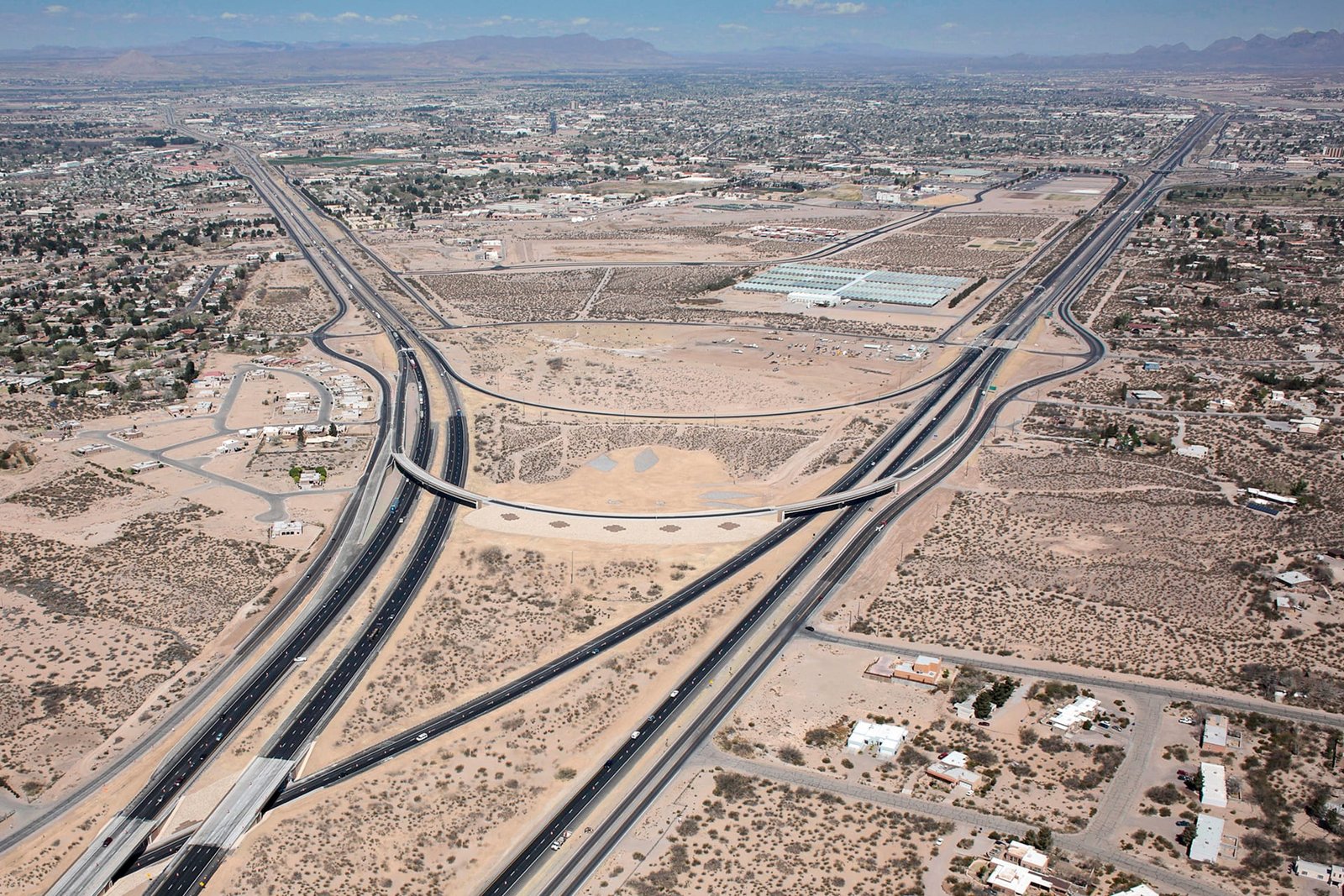
Pads, Paving and Utilities at the I-10 and I-25 Interchange
Every truck we send to a site near the Las Cruces interchange runs through the same few ramps, and so does every truck that serves our neighbors, which is why haul routes and pour timing come before anything else in our plans. Interstate 25 begins at I-10 Exit 144 just south of the NMSU campus. The interchange is a tri-stack directional T and the national southern terminus of I-25. On the I-10 exit list in Dona Ana County, Exit 140 is NM 28 (Avenida de Mesilla), Exit 142 is NM 478 (Main Street) with NM 101 and NM 188, and Exit 144 is I-25 north.
That cluster of exits gives a developer fast access to the valley's plants, supply yards and labor, and it puts large parcels within a short drive of the highway. For the concrete and earthwork contractor, it also means that nearly any project in the area has to share the same roads with commuters, university traffic and freight. We plan our truck routes, our pump set-ups and our water-truck schedules around those flows, and we tell owners and engineers what to expect before the first delivery.
Our work at the interchange is mostly pad preparation, mass grading, underground utilities, truck courts, paving and building slabs for industrial, commercial and logistics users. We manage it all and keep one schedule, so the owner is not coordinating five trades.
Haul routes, ramps and pour timing
A pour near a busy interchange has a different clock. We avoid peak traffic when we can, ask the plant for tighter dispatch windows and have a second route mapped in case an incident closes a ramp. For import, export and haul-off of fill, we schedule truck counts by hour and agree with the owner on where trucks queue, so none wait on a ramp or a shoulder.
Hot-weather pours get early starts, and we stage finishing crews to begin as the first truck rolls in. In winter we watch night temperatures and protect fresh concrete from cold. Even with good planning, one lane closure can change a day, so we keep the project trade crew size flexible and our contingency plans written down.
Building pads and truck courts near the ramps
Ground near the interchange often needs serious preparation. We start with mass grading to the elevations in the civil plan, balancing cut and fill where we can, then strip, scarify and recompact the building pad, bring in engineered fill where the geotechnical report requires it, and proof-roll the surface before any footings are dug. Utility trenches follow, compacted in lifts and tested.
Truck courts and dock aprons are built heavier than a standard parking area. We place thick, doweled concrete panels, set joints to avoid the wheel paths and slope the pavement to inlets. A distribution center built here needs a floor that carries racking and forklifts, aprons that handle the trailers, and drainage that keeps water away from the dock doors.
Acreage close to the interchange
The City of Las Cruces Innovation and Industrial Park sits at the junction of I-10 and I-25, with 400+ acres shovel ready and another 500 acres available for lease or purchase. That much open land near the interchange attracts industrial, logistics and commercial buyers, and each one wants to know how quickly the ground can be ready.
We help owners compare parcels by looking at grades, drainage paths, nearby utilities and access points, and by sketching how a pad and a truck court would fit. A short, honest conversation at that stage can reveal the cheaper of two sites. Nearby places such as Las Cruces International Airport and the NMSU campus add their own traffic, and we map those flows into our plans.
One schedule from clearing to the last joint
Because we coordinate the excavation, grading, trenching, forming, reinforcing, placing and finishing, the interchange schedule is ours to manage. A grader can leave the pad and a form crew can start the next day without a call to a subcontractor. When a delay hits, we can shift crews to a different part of the job rather than send them home.
We also coordinate directly with testing labs and inspectors, and we keep records ready to hand over. For projects that tie to US 70 off Exit 135 or to NM 28 at Exit 140, we plan the access permits at the start, since highway work can add review time that the concrete schedule has to respect.
What affects cost near a major interchange
Traffic control is a real cost item near ramps, and so are restricted hauling hours and the time trucks spend queuing. We price those items clearly. Imported fill, aggregate base and the thickness of heavy pavement tend to dominate the rest, so we offer alternatives when the owner wants to compare, such as a thicker slab on a lighter base or a stabilized subgrade that lowers the amount of import.
Early information saves money. A geotechnical report, a survey and a utility locate done before bidding give us numbers we can trust. When owners bring those with a site plan, we can usually produce a firm price with fewer allowances. Owners can read more about how we work with logistics and warehouse developers on similar sites.
Who builds near the interchange
Industrial users appreciate the interchange for its reach and the park for its open land. Industrial and manufacturing owners need floors that hold equipment, pads for heavy machinery and drainage that handles washdown and storms. Commercial developers choose the same area for pad sites that need quick highway access, and they want paving, curbs and utilities ready on a fixed date.
Plan your interchange parcel
Send us the parcel and the use. We will map the haul routes, check the ground and return a pad-to-paving plan with a price.
Questions Owners Ask
How do you keep deliveries moving near a busy interchange?
We map a primary and backup route, schedule deliveries outside peak traffic when possible and brief drivers on the final approach. For large pours, we ask the plant to dispatch in a steady rhythm and hold trucks off the ramps until the crew is ready.
What does a shovel-ready parcel still need from a concrete contractor?
Shovel ready usually means access to utilities and zoning is in place, but the pad still needs grading, compaction, utility tie-ins and paving. We review the survey and geotechnical report and tell you what remains to be done and what it will cost.
Can I get a price before I own the land?
Yes. If you share the site plan or a rough layout, we can provide a planning-level price for grading, utilities and paving. It will include assumptions that we list, and we refine it once the soils report and survey are complete.
How do you handle highway right-of-way requirements?
We identify which road owner controls the access, apply for the permit early and follow the traffic control plan. Work in a state right-of-way often has its own lead time and inspection process.