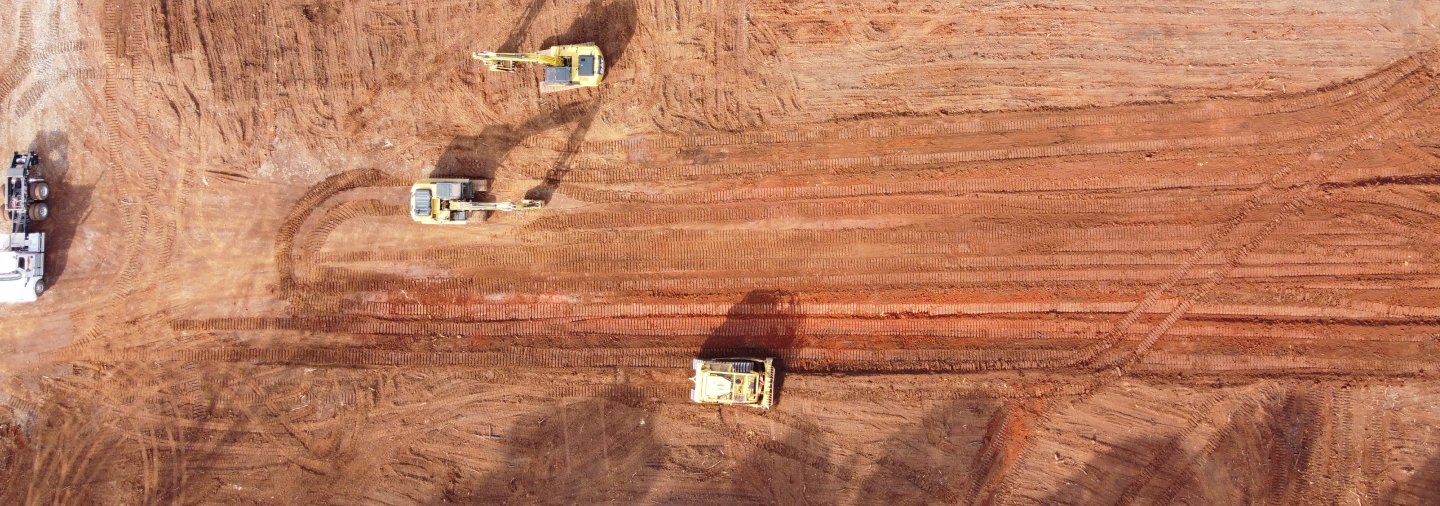
Mass Grading for Industrial and Commercial Sites in Las Cruces
Moving dirt is cheap until you have to move it twice. The whole craft of mass grading is deciding, before a scraper turns, where every yard is going to end up: which cut feeds which fill, how far it has to haul, how wet or dry it is and how it will be compacted. A good plan on paper is worth more than a big fleet in the field.
The scale of dirt work in this metro is large and getting larger. The City of Las Cruces lists more than 400 acres of its Innovation and Industrial Park as shovel ready, with another 500 acres available, and the park is adjacent to Las Cruces International Airport. Project Jupiter, a 1,400 acre data center under construction in Santa Teresa, is the biggest site in the region, and the city hopes to extend two runways at the airport to 8,600 feet and 10,500 feet. Each of those starts with a surface that has to be shaped, drained and compacted.
We handle the planning, the earthwork and the testing for large pads, roads and basins.
Big flat parcels and the dirt they need
Much of the land in the Las Cruces area is flat to gently sloping, which makes it attractive for warehouses, plants and campuses. Flat does not mean easy. A site that looks flat still has swales, old field boundaries and a drainage path that the new grading must respect. Mass grading reshapes that surface so water leaves the pad, building floors sit at the right elevation and truck courts drain without ponding.
The land is also dry and windy. Spring afternoons can bring blowing dust, and arroyos carry water after heavy thunderstorms. Both facts shape how we stage the work: limiting the area opened at one time, watering, and building temporary berms and basins so a storm does not push the new pad into a neighbor's field.
What mass grading covers
Mass grading begins after site clearing and grubbing and runs until the site is at rough grade, ready for fine grading and paving. It includes stripping and stockpiling topsoil, cutting high areas, filling low areas, compacting in lifts, shaping pads, ditches and berms, and moving surplus off site or importing what is missing. The principles are laid out in our work on cut and fill earthwork.
We aim for a balanced site, where the cut equals the fill plus a small allowance for shrinkage, and nothing needs to travel far. When the balance is off, we import or export, which costs real money, and our notes on import, export and haul-off explain how we manage truck cycles and disposal.
Survey control, lifts and proof-rolling
The job starts with survey. We stake the site, set grade control and plan haul routes before the first pass. Scrapers, dozers, graders, water trucks and compactors work together in a loop. Fill is placed in thin lifts, moisture-conditioned and compacted to the density the geotechnical report requires, and the testing technician checks each lift.
At the end of a stage we proof-roll the subgrade with a loaded truck to find soft spots that testing may have missed. Any area that pumps or ruts is excavated and replaced. Pad preparation, the finish step for a building site, is covered in building pad preparation. The aim is a stable, uniform base that the foundation or slab can rely on.
Keeping the dirt work under one schedule
When earthwork, utilities and concrete are performed by separate companies, hand-offs cost days. We coordinate the grading, the utility trenching and the concrete, so the grade is set for the pipe and the pad is ready for the slab. When the engineer changes a detail, we adjust the dirt work quickly because one team is coordinating the whole sequence.
That also lets us build in the right order. We rough-grade the site, install deep utilities, finish the pad and then place the base and the concrete. A subcontractor-based sequence may lose time in each hand-off. For clients who prefer a single point of contact, this is a major advantage, and for clients who bring their own earthwork team, we coordinate with them just as closely.
Setting realistic production
Production depends on haul distance, material type and equipment. A tight cut-to-fill site can move a great many yards per day; a site with a long haul or poor material moves far fewer. We estimate production, build a schedule with float for weather and revisit it weekly. The permit timeline and the geotechnical approvals often set the start date.
Monsoon season requires planning. Surfaces that are graded and left bare are vulnerable, so we aim to finish and stabilize each area before the storms. For long jobs, we protect finished grades with temporary controls and re-shape any area damaged by a storm. That is why large projects near the I-10 and I-25 interchange are best started well ahead of summer.
What drives the cost of moving dirt
The cost of mass grading is mainly volume, haul distance, material quality and compaction requirements. A site with excess cut that must be hauled away costs more than one that balances. Wet, rocky or oversize material slows production and may need processing. Tight density requirements, such as those for a heavily loaded pad, increase testing and the number of passes.
Water is a hidden cost in a dry climate. Moisture conditioning for compaction and dust control can use many truckloads a day. We plan the water source early and include it in the price. We also provide unit prices for common unknowns, such as unsuitable soil removal or extra import, so you can see the effect of a change before it happens.
Who we grade for
Industrial and manufacturing owners need large level pads with good drainage and truck access. Logistics and warehouse developers need speed and certainty, especially when speculative buildings such as the 365,000 and 135,000 square foot warehouses built in the Santa Teresa area are planned on tight timelines. Public owners need the same discipline for airports, roads and basins.
Whatever the buyer, the conversation starts with the same questions: how much dirt, how far, how wet and how soon. We answer those with numbers, a schedule and a plan for the weather.
Bring us the grading plan
Send us the topographic survey, the grading plan and the geotechnical report, and we will return an earthwork estimate with a cut and fill balance, a haul plan and a schedule built around the weather and your permits.
Questions Owners Ask
How do you estimate cut and fill before we have a final design?
We use the survey, the preliminary grading plan and the geotechnical report to estimate volumes and shrinkage. The number will move as the design settles, so we show the range and the assumptions. Once the plan is final, we update the estimate and look for ways to balance the site.
What compaction do you need for a building pad?
The geotechnical engineer specifies it, usually as a percent of maximum dry density at a moisture range, in lifts of a set thickness. We follow the report, have the testing agency check each lift and re-work anything that fails.
Can grading start before the building permit?
Often under a separate grading permit, but it depends on the jurisdiction and the project. Ask the design team and the city or county which approvals cover the earthwork. We help with the sequence so the dirt is ready when the building permit arrives.
How do you control dust during mass grading?
Water trucks, limited open areas, stabilized haul roads and wind-based work stoppages. A dust plan is usually part of the permit. We log water use and adjust when conditions change.
What if the soil is not suitable for fill?
We stop, document and tell the engineer. Options include drying, mixing with other soil, treating with lime or cement or replacing it with imported material. Each has a cost and a schedule effect, and we put numbers on them.