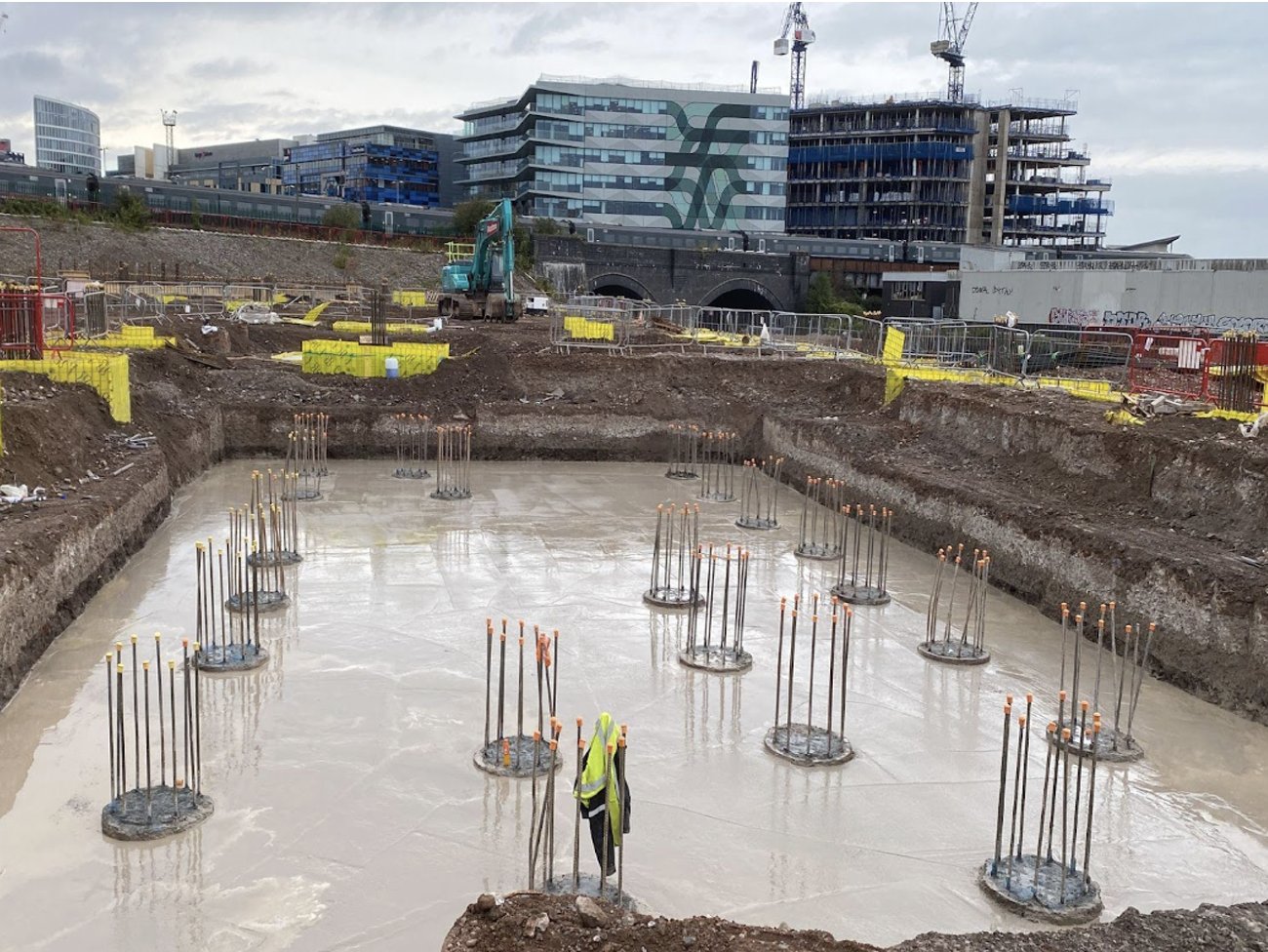
Cut and Fill Earthwork for Large Sites in Las Cruces
Every cubic yard has two addresses on a cut and fill job: where it comes from and where it ends up. The cheapest earthwork is the kind where those addresses sit on the same site and close together, so the first thing we ask for is the grading plan, the earthwork quantities and the geotechnical report. From those we build a haul plan that moves dirt from high ground to low ground over the shortest practical distance, and we say plainly whether the site balances or will need material brought in or hauled away.
Large parcels in southern Dona Ana County are shaped to drain, and the scale is real. The Santa Teresa Gateway Rail Park covers 1,100 acres, and a 1,400 acre data center is under construction at Santa Teresa. At that size earth movement stops being a detail and becomes a schedule driver, because a half mile of extra haul on every load adds up faster than any equipment choice can recover.
We run cut and fill for developers who need pads and streets shaped on a raw parcel, including logistics and warehouse developers, and as the first phase of land development infrastructure packages where the grading sets the elevation for everything underground.
What large parcels near the border ask of an earthwork crew
Logistics growth along the border has produced pads measured in hundreds of thousands of square feet. In 2022 local reporting described private builders constructing speculative warehouses of 365,000 and 135,000 square feet near Santa Teresa, and each one needs a level, drained, compacted footprint plus truck courts and trailer parking around it. The same ground is now seeing data center work. Pads of that size push the earthwork plan toward whole-site balance instead of one building at a time.
Open desert gives you room to work and almost no protection from wind, so dust is the visible risk and water trucks are part of the production rate. We also plan where surface water goes during construction. Arroyo flow is a fact of life in this part of New Mexico, so cut slopes and fill slopes are shaped and, where needed, protected so one thunderstorm does not re-grade the site for us. That is why we tie the earthwork plan to erosion control and stormwater pollution prevention from the first day. Our work at Santa Teresa follows that pattern.
Quantities, shrink and swell, and what the numbers hide
Earthwork quantities on a plan are theoretical. Soil that is cut loosens and grows in volume, then compacts into fill at a different volume again, so a site that appears to balance on paper can come up short or long once the dirt has been placed in lifts and compacted. We compare the engineer's numbers with what the geotechnical report says about the material and flag it early if the shrink or swell assumption looks off. It is better to raise that at bid time than to find it with half the site finished.
Unsuitable material is the other surprise. Organic soil, debris or soft zones found in a cut cannot always be reused as structural fill, and fill under buildings and slabs carries stricter requirements than fill in a landscape strip. We stockpile and test, keep material for pavement areas apart from material for building areas, and turn to over-excavation and recompaction when a soft area has to be removed and rebuilt rather than covered up.
Equipment, grade control and the crew running it
Cut and fill is production work. Scrapers, dozers, loaders and haul trucks are matched to the haul distance: scrapers do well on long, open hauls, while articulated trucks and excavators suit tight sites and wet ground. We choose by the haul plan, not by what happens to be parked in the yard. Machine-guided dozers and graders hold design grade between survey checks, which cuts the second pass and the rework in fill lifts.
Fill goes down in thin lifts, each conditioned to the right moisture and compacted before the next, and every lift is a place where a rushed crew can leave a weak layer. We keep a water truck and compaction equipment running with the placement instead of behind it, because dry fill compacted late is fill that fails the test. Our supervisors walk the lifts with the testing technician so a failing result is corrected the same day.
Sequencing earthwork with utilities and haul routes
Cut and fill needs a clear order. Deep utilities generally go in before final fill so trenches are not cut through fresh compacted lifts, yet overall site grades must be roughed in early so there is somewhere to set the pipe. We map those two needs against each other, and on a big site we phase the work so one area is being filled while another is still being cut.
Haul routes inside the site need as much planning as roads outside it. Road crossings, existing pipelines and overhead lines all constrain scrapers, so we mark them and plan crossings on stabilized ground. When material has to come from or go to another site, interstate access shapes the route. From the south of the county, exit 155 serves NM 227 toward Vado and Berino, and exit 162 serves NM 404 toward Anthony and Chaparral, and we pick the exit that keeps trucks off local streets.
What drives the cost of moving dirt
The big three are haul distance, material type and compaction requirement. A short haul in good soil with a modest density specification is cheap per yard, while a long haul in material that needs drying, wetting or blending is not. Fuel, water and trucking are the variable costs, and on a hot, dry site the water needed for dust control and moisture conditioning can surprise owners who did not budget for it.
We price by the cubic yard, show import and export quantities separately, and list water and testing allowances plainly. If a site is short on material, buying and hauling it costs more than moving existing dirt, so a better grading plan can pay for itself. We are glad to review a plan before bid and suggest finished-grade changes that reduce the quantity moved, as long as the engineer approves them.
Planning a site that needs shaping?
Send the grading plan and the soils report. We will return a haul plan, a balance check on the quantities and a production schedule you can plan other trades around.
Questions Owners Ask
How do you know whether my site will balance?
We take the cut and fill volumes from the grading plan, apply shrink and swell factors from the geotechnical report and compare the totals. A site that is close gets balanced by adjusting finished grades with the engineer. If it is far off, we price the import or export as its own line so the number is not buried.
Why does dirt change volume once it is placed?
Excavated soil is loose and takes more room than it did in the ground. Compaction squeezes it back down, often to less than the original volume. The final number depends on the soil, the moisture and the density you specify, which is why we ask for the report before quoting.
Can excavated material be reused as structural fill?
Often, if it passes the gradation and organic limits in the specification and is placed at the right moisture. We test samples, keep suitable material in separate stockpiles and send anything unsuitable to a disposal site. The geotechnical engineer has the last word.
How do you control dust on a big earthwork job?
Water trucks run on a schedule tied to wind and haul traffic, speeds are held down on haul roads and we stop work in the worst gusts. On long jobs we stabilize the most-traveled roads with aggregate. A stormwater permit also expects the controls to be documented, and we keep that record.
How long does a large cut and fill job take?
It depends on total yardage, haul distance and the number of machines the site can use at once. We give you a daily production rate and a phase plan, not a single end date, so you can see how a rain delay or a utility conflict shifts the schedule.