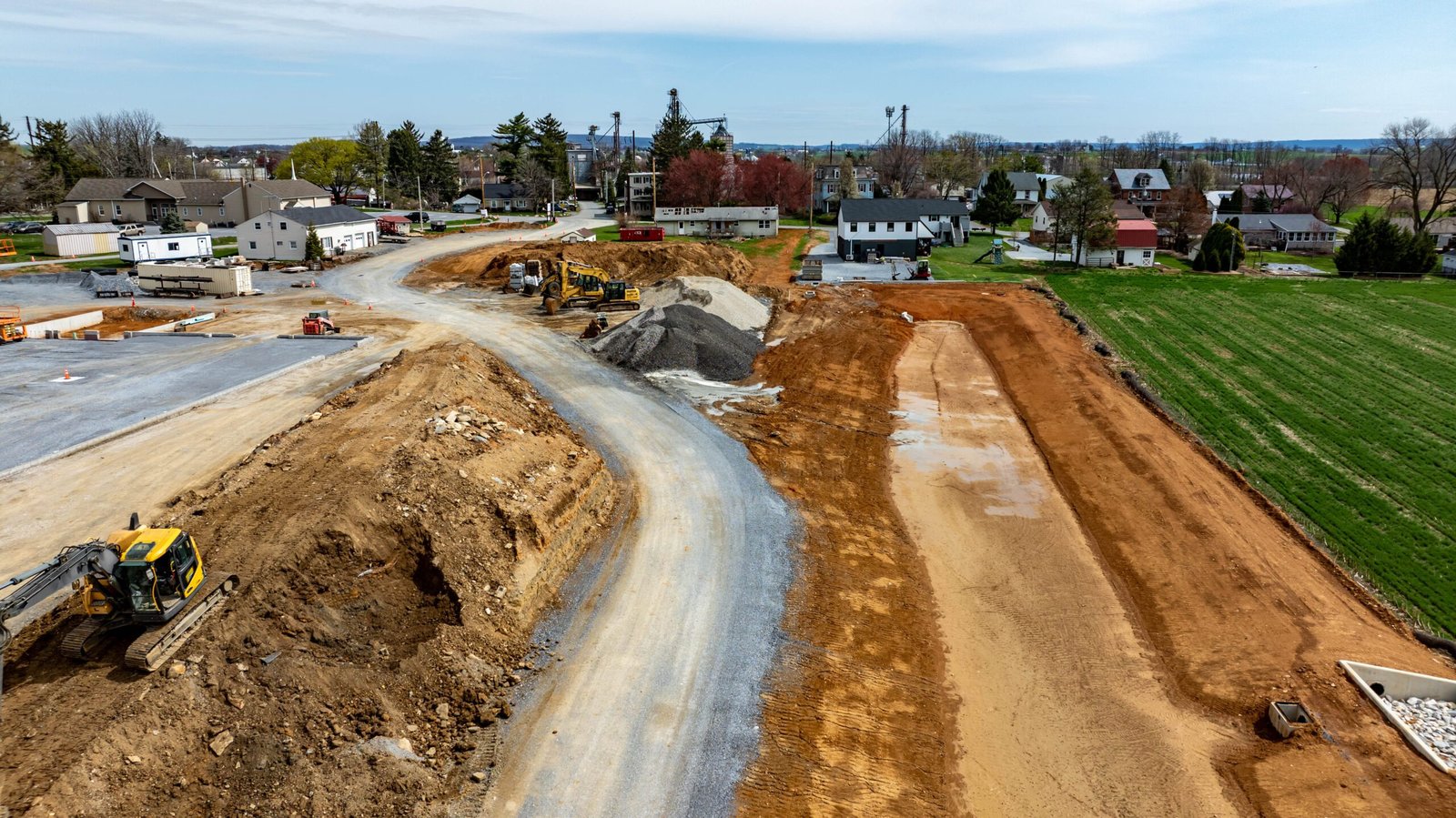
Land Development Infrastructure for Southern New Mexico Sites
A raw parcel has no streets, no water, no sewer and no drainage, and somebody has to build all four in the right order. Land development infrastructure is that order: clearing, mass grading, utilities, storm drainage, curb, subgrade and base, delivered as lots or pads that a vertical builder can take over and start building on. It is the work that turns acres into sites.
Southern New Mexico has sites at scale. The city lists more than 400 acres shovel ready at its Innovation and Industrial Park, with another 500 acres available for lease or purchase, and the revised annexation proposal at Rancho Santa Teresa covers approximately 362 acres. Parcels of that size are developed in phases, and the first phase decides whether the others can follow without ripping up finished work.
We build the site side of that equation: the earthwork, the underground and the roads, for developers and public owners who want one contractor coordinating those pieces. Related scopes include site utilities and mass grading.
Phasing a development so nothing is torn up twice
The right order is rough grade, then deep utilities, then storm drainage, then shallow utilities and conduits, then curb, subgrade, base and paving. Reverse any pair and something gets dug up. We build the schedule around the utilities that are deepest and most dependent on gravity, usually sewer and storm drain, because their grades set everything else.
Phasing lets the developer sell or lease lots earlier. We prepare each phase so streets, utilities and pads are complete and stable, with temporary erosion controls and drainage in place for what remains. Between phases the site must be left safe: slopes stable, trenches closed, open basins fenced. A phase left open through the storm season costs more than one built and stabilized on time.
Developers and public owners we build for
Speculative developers want phases finished on time and under budget so pad sales or leases can start. Logistics and warehouse developers care about truck-court elevations and access to highway or rail, while commercial developers and subdivision builders care about lot counts, fire access and the municipality's acceptance of the improvements.
Public owners such as a city or county sometimes build infrastructure themselves to open land for industry, then hand lots to private builders. Either way, the owner will inspect, test and accept the work, and our job is to deliver it with the paperwork that allows acceptance.
Pieces of a development package
A development package usually contains several services. On the earthwork side, site clearing and grubbing gets the land to a clean start, and grading follows. For the pipes, water main installation and sewer and storm lines go in before streets.
The streets finish the package with subgrade, base and curb and gutter. Because each piece depends on the one before it, holding them in a single contract with one superintendent reduces the finger pointing that sometimes follows when different contractors hand off to each other.
Plats, plans and approvals
Development has more approval layers than a single building: a plat or subdivision approval, construction drawings reviewed by the city or county, utility agency approvals, a grading and drainage plan and a stormwater permit. Before we bid we list which approvals exist and which are pending, because pricing work that has no approved plans invites change orders.
The buildings that follow fall under the 2021 New Mexico Commercial Building Code, which adopts the 2021 International Building Code as amended and took effect July 14, 2023. We build the infrastructure to the approved plans and the agency's standards, and we keep inspection logs and as-built records so the owner can close out and hand the improvements to the city or county.
Land, rail and highway in southern Dona Ana County
The land supply here is tied to transport. Interstates 10 and 25 meet at Las Cruces, the Santa Teresa port of entry and rail park sit near the border, and a state-backed plan reported in 2019 for the Santa Teresa industrial complex included a $40 million expansion of a rail swap yard and 2,400 linear feet of new in-house track. Development near that kind of infrastructure has to deliver truck access, utilities and drainage that match the users it attracts.
Annexation and growth are reshaping the edges too. When a city annexes land, like the area proposed by Sunland Park, the infrastructure standards and utility service areas can change, and a developer needs a contractor who can read both sets of requirements while pricing the work.
What a land development package includes
A typical scope covers clearing and grubbing, topsoil stripping, mass grading to balance, underground water, sewer and storm, dry utility conduits, street subgrade and base, curb and gutter, detention or retention areas, erosion control and final stabilization. We can price the whole package or the pieces, and we state what is excluded, such as asphalt or landscape, so no one assumes it is in.
Quantities in a development are large and unit prices drive the contract. We use unit pricing for items likely to change, such as rock, unsuitable soil or extra pipe length, and a lump sum for stable items. We submit pay applications by phase with quantities verified by survey, which makes it easier for lenders and owners to follow progress.
What moves a development budget
Grading balance, depth of utilities and the length of the street network drive most of the cost. A site that balances on cut and fill saves trucking, while a site that needs import adds it. Deep sewer into a shallow outfall means more excavation, shoring and dewatering, and long, narrow lots spread the same utilities across less frontage and cost more per lot.
Time is a cost as well. A development financed with a construction loan carries interest while the contractor works, so an extra month of weather delay costs real money. We build contingency into the schedule for storm-season rain and propose phasing so early lots can sell sooner. Soft costs such as testing, inspection and permits belong in the budget, and we list the ones that fall to us.
Have acres to turn into lots?
Send the plat, the grading and utility plans and your target phases. We will return a phased price, a schedule and a list of approvals that need to be in place before we mobilize.
Questions Owners Ask
Can you build just one phase?
Yes. We price a phase on its own but look at how it connects to the whole plan, so utility stubs, grading and drainage leave the next phase workable. The cost of stubbing and temporary controls is part of the phase price, not a surprise later.
Who handles testing and inspection?
The owner usually hires the testing lab, and the city, county or utility inspects the improvements. We schedule our work around their visits and keep logs. If a test fails, we correct it at our cost when it is our work.
How do you handle water and sewer connections to existing lines?
We confirm the tie-in point and the owner's requirements, locate the existing line by potholing and coordinate the shutdown with the utility. Tie-ins are scheduled to avoid disrupting service for neighbors for longer than the utility allows.
Do you build the streets too?
We prepare the subgrade and base, set curb and gutter and coordinate with the paving contractor. Asphalt or concrete paving can be included or priced separately, depending on how you want to bid the package.
How do you protect finished work during phasing?
We stabilize slopes, plug open pipes, fence basins and leave drainage paths clear. We also keep a record of where each utility ends so the next phase connects cleanly without searching.