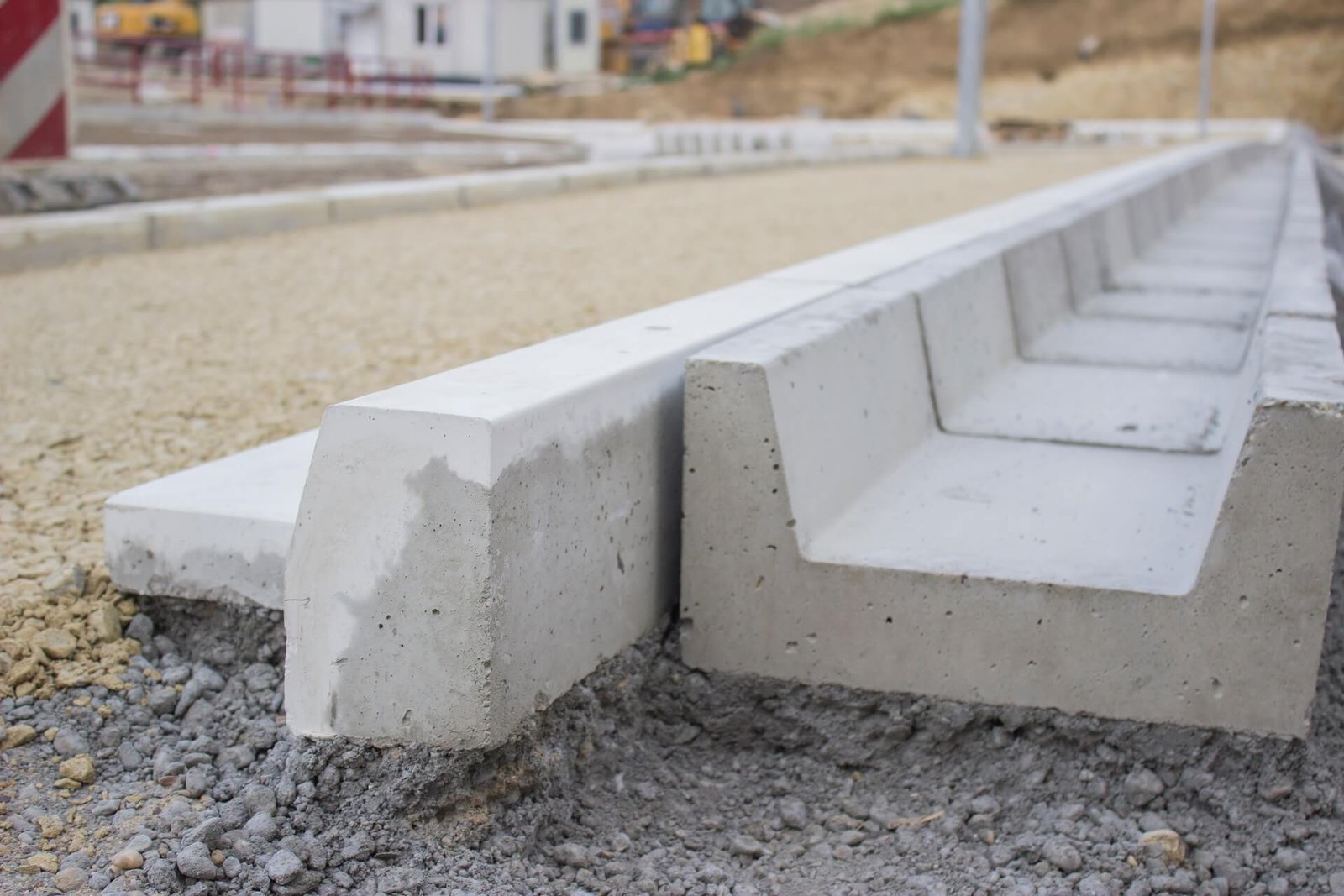
Curb and Gutter Concrete in Las Cruces and Dona Ana County
Half an inch of error in a gutter line is enough to hold a puddle, and a puddle in a parking lot shows up on the owner's list every time it rains. Curb and gutter carries storm water to inlets, keeps pavement edges from breaking up and separates parking from landscaping. It is a drainage structure first, so we build it to grade before we think about how it looks.
Around Las Cruces, that job comes with desert rain. The surrounding arroyos are dry streams that carry water after heavy thunderstorms, and a parking lot in the middle of a development can see a surprising volume of runoff in a short burst. We coordinate curb setting and pouring so the flow line drops cleanly to each inlet, with no flat spots and no high points between.
The same skills show up in public work. A $1.5 million U.S. Economic Development Administration grant, reported in 2010, paid for infrastructure at NMSU's Arrowhead Research Park, including widening Arrowhead Drive from two lanes to four, finishing the wastewater system and adding street lighting. Road widening and curb work always go together, and we build both sides of that equation.
How curb is set to grade and placed
We run curb by hand-formed methods and with slipform machines, depending on length and the profile. Hand forming suits short runs, radii, transitions and custom shapes, and it lets the crew set steel forms to string line and adjust them to the design grade. For long straight runs, a slipform machine places continuous curb at a steady pace and reduces joint count and labor.
In either case, grade control is survey-based. We take offsets from the engineer's stakes, set a string line and check the flow line with a level as the first section comes out. The base is compacted aggregate or a tied-in subbase from the paving contractor. Expansion joints go in at the specified intervals and at inlets, and control joints are tooled or sawn between them. For the road base underneath, see road subgrade preparation.
What curb and gutter work includes
The typical scope covers combined curb and gutter, vertical curb, drop curb at driveways, curb ramps, valley gutters, curb returns at intersections and header curbs along pavement edges. In commercial parking lots we also pour wheel stops and island curbs. In public street work we follow city or county standard details for profile, joint spacing and curb ramp design.
The drainage interface matters. Gutter lines lead to inlets, curb openings or scuppers, and each of those has its own formwork and reinforcement. Where a gutter meets a storm structure, we coordinate with the crew doing storm drain installation so the rim elevations and the gutter slope match before concrete arrives. A frame set one inch high is a puddle that will never go away, and finding it with a level before the pour is a ten minute job, while finding it after is a saw and a jackhammer. We also walk the finished gutters after the first heavy rain whenever the schedule lets us, because that is when the real flow lines show.
Standards, materials and inspections
Public curb and gutter follows the standard drawings and specifications of the agency that owns the street, and private parking lot curb follows the project plans. The mix is usually a structural mix with air entrainment where specified, tested for slump and strength. Reinforcement, if any, is shown on the drawings, and dowels may tie curb to pavement or sidewalk.
The 2021 New Mexico Commercial Building Code, which adopts the 2021 International Building Code as amended and took effect July 14, 2023, applies to the building, and the site work around it falls under local and state requirements. Curb ramps must meet accessibility standards. We get inspections for forms before we place, and we leave test cylinders for the testing lab as the specification requires. The agency inspector may also check the finished flow line with water.
Sequencing curb with paving, utilities and landscaping
Curb and gutter follows underground utilities and rough grading and precedes paving. On a parking lot, the usual order is utilities, subgrade, curb, base course, paving and striping. If the curb comes after the base, forms rest on a prepared surface but the work is more disruptive. If it comes before, the curb acts as a guide for the paving crew.
The location matters. Work near the Interstate 10 and 25 interchange, which includes exits for Avenida de Mesilla, Main Street and University Avenue, often involves traffic control and tight working hours. We coordinate lane closures and keep trucks out of the travel lane. In the hot months we pour early and cure promptly to prevent plastic cracking along the narrow gutter section.
Who we build curb for
Residential developers building subdivisions, commercial developers building shopping centers, and municipal owners improving streets all need curb. Homebuilders and multifamily developers typically want fast production on long runs, with consistent profiles and minimal rework. They also care about driveway cuts and ramp locations being right the first time.
For multifamily and mixed-use projects, curb is used at fire lanes, loading zones and landscape islands. We work with the civil engineer and the paving contractor to prevent conflicts, such as a curb that blocks a drainage path or an island that cuts into a truck turning radius. Where the work includes concrete paving, we pour the curb and pavement in a coordinated sequence.
Have a curb package to bid?
Send the civil plans and the standard details. We will price it by linear foot with ramps and returns separated and show the sequence with the paving crew.
Questions Owners Ask
Can curb and gutter be poured in hot weather?
Yes. We start early, keep the base damp and cure right away. Curb has a lot of exposed surface area for its volume, so it dries faster than a slab, and we adjust the mix and finishing accordingly.
How often are joints placed?
Joint spacing is set by the project standards, often every ten to fifteen feet for control joints, with expansion joints at structures and at the end of runs. We follow the drawing and adjust only with approval.
What happens if the gutter holds water?
We check the flow line before the concrete sets, and we correct it. After the concrete is hard, a bird bath can often be fixed by grinding or, in worse cases, removing and replacing the section.
Do you do both machine-formed and hand-formed curb?
Yes. Machine placement is efficient on long straight runs, while hand forms are better for radii, ramps, transitions and short sections. We choose the method that gets the grade right.
Is a permit needed for curb in a public right of way?
Usually the agency that owns the street requires a permit and inspection. We coordinate with the engineer and the agency so inspections are scheduled before forms are filled.