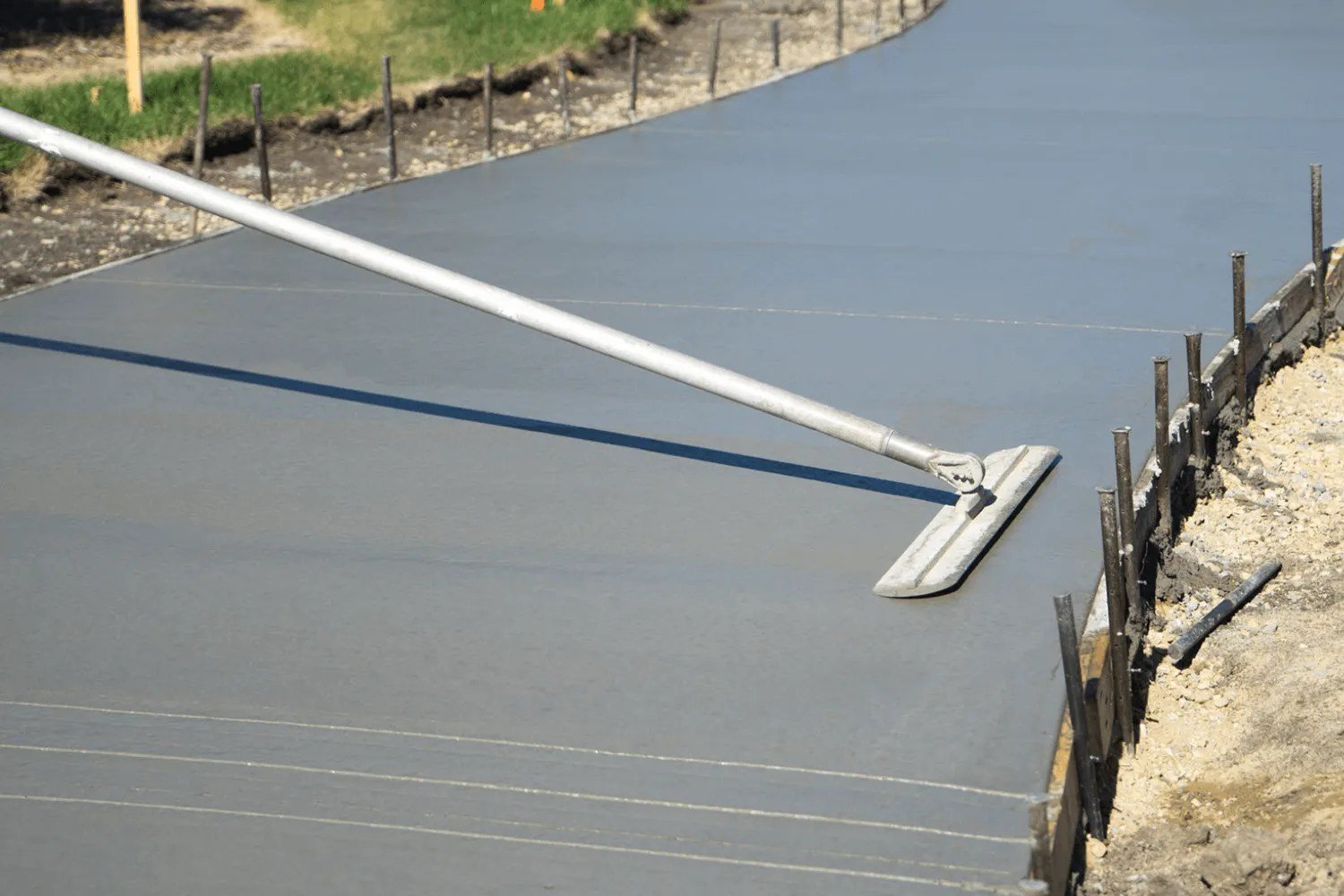
Concrete Paving for Commercial and Industrial Sites in Las Cruces
Slow, heavy turning wheels will push a hot asphalt surface around in July, and fuel, oil and standing trailers do the rest. That is the reason owners with yard traffic, container handling or repetitive truck movements ask us about concrete pavement. A properly designed and built concrete pavement does not rut, does not soften in the heat and takes point loads like landing gear and trailer dollies without deforming.
The reasons show up in the Las Cruces area's freight and aviation infrastructure. The Santa Teresa Gateway Rail Park covers 1,100 acres and is served by the Santa Teresa Southern Railroad, which interchanges with the Union Pacific. At Las Cruces International Airport, utilities, lighting and taxiways were being extended on the east side to support hangar development. Both settings combine heavy wheel loads with a lot of standing, turning traffic.
The rest of this page explains how we approach a concrete paving job, from the design questions that decide thickness to the weather calls that decide the pour date.
Where concrete pavement earns its cost here
The best candidates are places where vehicles stop, turn or park under load: truck courts, container yards, bus and fleet yards, fuel islands, entrance aprons and areas around aircraft hangars. Heat softens asphalt, while concrete keeps its stiffness. Fuel and oil that would soften asphalt leave concrete mostly unchanged. The reduced maintenance cost over a long service life often balances the higher initial cost.
For owners in the freight sector, we often start with truck courts and dock aprons, where the combination of dolly loads and turning trucks is hardest on any surface. Aviation owners ask about ramp and apron areas next to hangars. Developers who want a parking lot with a long design life consider parking lot concrete, particularly at entrances and drive aisles. In each case, we start with the loads and the traffic pattern.
Design and site questions that set the thickness
The pavement design is set by the engineer from the traffic loads, the subgrade support, the concrete strength and the expected life. Our job is to ask the right questions early: what wheel loads, how many repetitions, what turning movements and whether the pavement will carry fuel trucks or heavy forklifts. The answers change thickness, joint pattern and the need for dowels.
Subgrade matters at least as much as the slab. A uniform, well-compacted subgrade, often with an aggregate or treated base, prevents pumping, faulting and corner cracks. We confirm density and moisture, proof-roll and fix soft spots before placement. Where the existing soil is unsuitable, solutions like engineered fill and soil stabilization can be priced as options. We also walk the site for drainage, since water that stands on the pavement edge softens the base. In a region where an afternoon storm can drop a lot of water in minutes, we want the grade to carry it off the pavement and away from the subbase, not under it.
Specifications, joints and who inspects
Pavement specifications are usually written by the civil engineer for the owner, or by the airport or agency for public projects. They address mix strength, air, slump, thickness, dowels, tie bars, joint layout, finish, curing and tolerances. Sealed joints are common on exterior pavements to keep water and debris out.
The 2021 New Mexico Commercial Building Code adopts the 2021 International Building Code as amended and took effect July 14, 2023, and it governs the buildings next to the pavement. For the paving itself, the plans and local requirements prevail. Inspectors check the subgrade, forms, dowels and reinforcement, and the testing agency samples the concrete. We record placement temperatures, time stamps and curing for every pour so the file is complete for acceptance. If airfield rules apply, we follow the airport's requirements for vehicle access, flagging and foreign object control.
Cost drivers for concrete pavement
Pavement is priced by area, thickness and the extras: dowels and tie bars, reinforcement, sawing and sealing, edge details and curb. A 10,000 square foot truck court at eight inches is about 250 cubic yards of concrete. A change of one inch in thickness shifts the quantity by about 31 yards, which is why the pavement design is the first place to look for savings or risk.
Access and phasing affect cost as well. If the yard must stay open to trucks, the work is done in lanes, with a plan for traffic. If the base needs treatment, that is an additional line. Owners in sectors like oil, gas and midstream, who need yard pavement that handles heavy equipment and spills, are often best served by a rigid pavement. We lay out the choices and the tradeoffs in the proposal.
Traffic, airfield and equipment safety
Paving crews work around moving equipment, and trucks delivering concrete back up repeatedly. We use spotters, designate haul routes and keep pedestrians out of the work zone. On operating yards and facilities, we coordinate with the owner's safety staff and use barricades and signs.
On airfield work, such as near Las Cruces International Airport, the requirements are more detailed: vehicle escorts, restricted areas, equipment height limits and cleanliness to prevent debris on active surfaces. Work near rail or hangars needs its own coordination. For hangars and similar structures, see our notes on aircraft hangars. We submit a safety plan with the schedule so the owner knows how we will protect people and operations.
Planning a yard or apron?
Send the traffic information and the civil plans. We will review the pavement design, price it by area and thickness and plan the pour sequence around your operations.
Questions Owners Ask
Is concrete pavement better than asphalt for truck yards?
For concentrated, slow or turning loads, usually yes. It resists rutting and fuel damage and lasts longer with less maintenance, though it costs more upfront. The best choice depends on traffic, soil and budget.
How thick should a truck court be?
The engineer sets it from the loading and subgrade. Heavy truck areas are commonly thicker than a typical parking lot. We build to the drawings and raise questions if the design seems to mismatch the traffic.
How soon can trucks use new concrete pavement?
Often after seven days, but the specification and strength tests control. In some cases, high early strength mixes allow earlier opening. We confirm with cylinders or maturity data.
Do you saw and seal joints?
Yes. Sawing happens within hours of finishing, and sealing follows after the concrete has cured. Sealed joints keep water and debris out of the base.
What does hot weather do to a concrete paving pour?
It speeds the set and dries the surface, which can cause plastic shrinkage cracks across a large pavement. We schedule early placement, dampen the base, use set-control admixtures where allowed and apply curing compound right behind the finishers. If wind and temperature are both high, we move the pour.