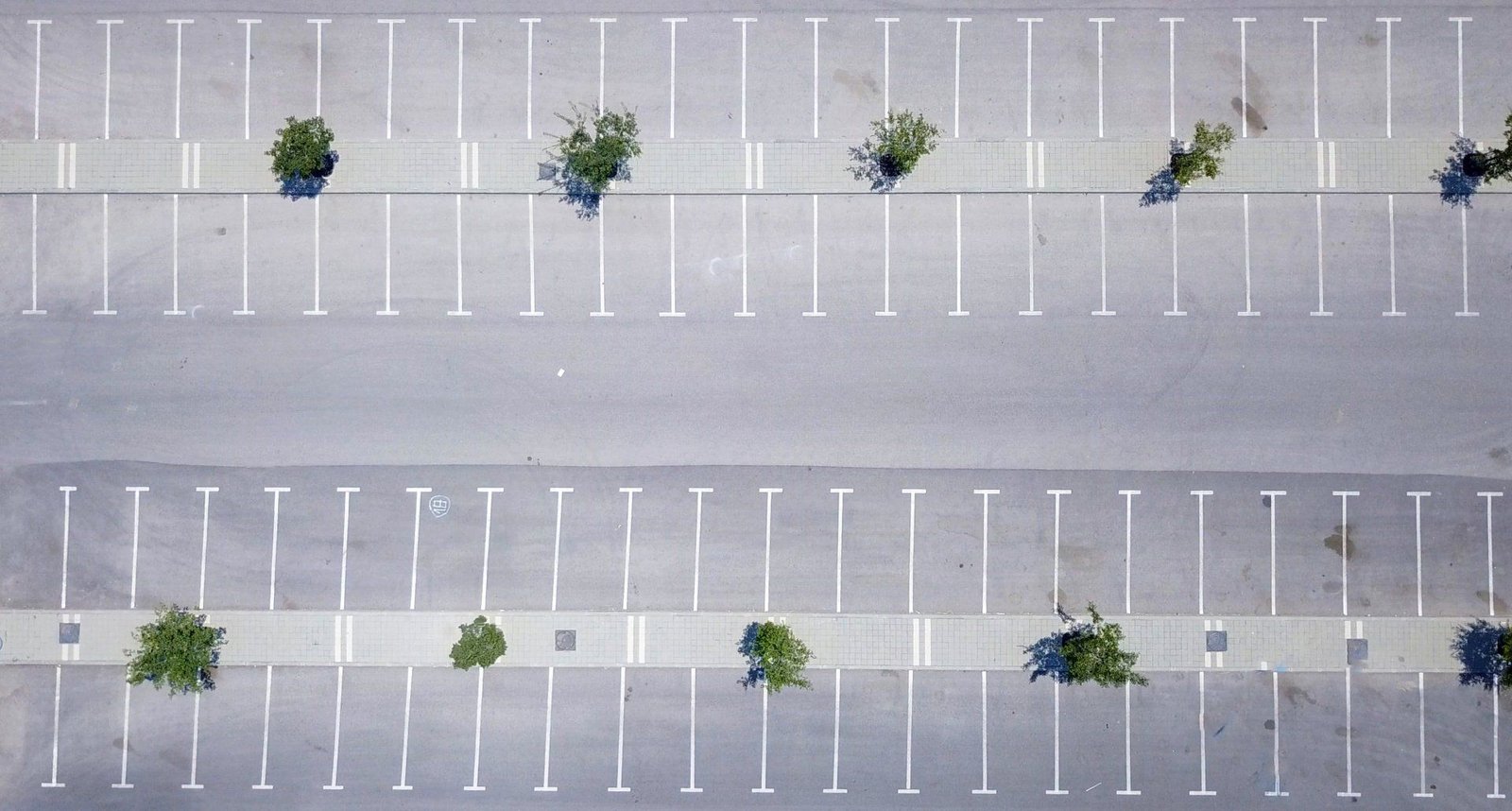
Parking Lot Concrete for Commercial Properties in Las Cruces
Some 4,500 parking spaces surround Mesilla Valley Mall, which opened in 1981 with 602,150 square feet of indoor space on 77.4 acres. That is a useful number to keep in mind when you think about parking lots, because a lot of that size is a civil infrastructure project in its own right: drainage, lighting, accessible routes, truck access for deliveries, landscape islands and years of daily traffic. The surface has to hold up to all of it.
We build concrete parking lots, drive aisles and fire lanes across the Las Cruces area for owners who are tired of sealcoating, patching and restriping every cycle. A concrete lot costs more on day one and then leaves the owner alone, especially where trash trucks, delivery vehicles and tight turning radii punish other surfaces. In a climate where summer pavement temperatures are brutal, concrete also stays stiffer and cooler underfoot.
Here is how we handle the work: who the lots are for, what is included, how we stage the pours without shutting down a tenant and what drives the budget.
Owners who ask for concrete lots
Developers and property managers are the largest group. Commercial developers building shopping centers, medical office parks and mixed-use projects use concrete where it pays off in life-cycle cost: trash enclosure pads, loading areas, entrances and fire lanes, and sometimes the whole lot.
Healthcare owners are another group. Near the hospitals around the MountainView medical district, ambulance bays, emergency entrances and patient drop-offs need smooth, durable surfaces that stay accessible all year. A medical office project adds van-accessible stalls and routes with slopes and clear widths that must be right, because accessibility complaints often start in the parking lot.
What a parking lot package covers
A complete package includes subgrade preparation, base, forms, reinforcement if specified, concrete placement, finishing, jointing, curing and sealing. It includes integral curb and gutter or separate curb, wheel stops, accessible stall slabs and ramps, dumpster pads and sidewalks along the lot. Striping follows after cure, usually by another contractor, and we coordinate timing so paint adheres properly.
The design must manage water. A lot sheds stormwater to curb openings or inlets, and the slopes must be steep enough to drain and gentle enough for accessible stalls, which commonly limit slope in all directions. We follow the grading plan, but we also point out places where field conditions will create trouble, like a stall with a cross slope that exceeds the limit. Related work includes curb and gutter and ADA ramps and accessible routes.
Staging pours while the property stays open
A working shopping center cannot close its parking lot for a week. We divide the lot into phases and pour in sections that keep access to the main entrances and the accessible stalls. Before each phase, we mark detours, set barricades and notify tenants. Pours at night or on slow weekdays reduce disruption, and we always leave a signed, barricaded path for fire access and for customers with limited mobility.
Each phase follows the same pattern: demolition and removal if it is a replacement, subgrade correction, base, forms, placement, finish and cure. The cure is the main constraint, since vehicles cannot return until the concrete reaches the specified strength. We use cylinders to confirm and, with warm weather, often open sections sooner than owners expect. For the base under a lot, see paving base preparation, which uses a similar approach to aggregate base and compaction.
Pricing a lot: what matters most
The primary driver is area and thickness. A typical light-duty lot might be five or six inches, with thicker sections in drive lanes and truck areas. Reinforcement, dowels at joints, curb type, the number of islands and the amount of demolition all change the number. A 40,000 square foot lot at five inches needs about 620 cubic yards.
Phasing is the hidden cost. A lot that must stay open takes more mobilizations and more traffic control than one that can close. Subgrade is the other swing, since soft areas can add cost and time. We include allowances for undercut and recompaction where soils are uncertain and report how much we used. Owners comparing concrete with asphalt should look at the whole life cost, including crack sealing, seal coating and repaving, and we can help build that comparison.
Parking lot work across the metro
We work in Las Cruces and across Dona Ana County, from older retail corridors to new developments near the interstates. Redevelopment projects often involve replacing a failed asphalt lot with concrete, which requires demolition, haul-off and drainage corrections. New projects near the I-10 and I-25 junction allow us to build a lot from a clean subgrade.
At properties like Mesilla Valley Mall, which lists 85 stores and five major tenants, a lot has to handle customers, employees, delivery trucks and emergency vehicles. We pay attention to the heavier loads near loading zones and trash enclosures, and we set those areas apart in the design so we can thicken or reinforce them. Our Mesilla Valley Mall area page explains more about the retail corridors we serve.
Considering concrete for a lot?
Send the site plan, the traffic types and your phasing needs. We will price the lot by area and thickness and lay out a phased pour plan.
Questions Owners Ask
How long before we can drive on a new concrete lot?
Typically seven days for normal traffic, sooner with high early strength mixes if tests confirm. We provide the opening date based on cylinders and weather, not a fixed calendar.
Can you replace one section of a lot?
Yes. We saw out the failed section, dowel into the existing slab, place new concrete and cure. Matching the existing joint pattern is part of the plan.
Does concrete need striping?
Yes, once cured. Paint or thermoplastic markings go on clean, dry concrete. We coordinate with the striping contractor, and we recommend waiting for cure compound to wear off or using compatible products.
How do accessible stalls work with slopes?
Accessible stalls and access aisles have tight slope limits in all directions. We form them carefully, check with a digital level and finish them in a way that stays within the limit. Wet stalls can be corrected before the concrete hardens but not afterward.
Will a concrete lot get too hot?
Concrete surfaces reflect more sunlight than dark asphalt and usually feel cooler underfoot. They still get warm in summer sun, but they tend to stay cooler and stiff.
What do you need to see before pricing a replacement lot?
A survey or civil plan, photos of the failed areas, the utility locations and any drainage complaints. We walk the lot, probe the failed areas to see whether the base is wet or the subgrade has moved and note where water collects. That walk tells us more than the drawings about how much undercutting to carry.