Water Main Installation for Commercial Sites in Dona Ana County
A water main is only as good as its last joint, and the last joint is usually the one made at the end of a long day with the trench filling in. That is the fact that shapes how we run pipe. We keep trench lengths short enough to close, we keep bedding clean, and we pressure test before anyone talks about paving.
Demand for new water service in southern Dona Ana County is easy to see. Project Jupiter, a 1,400 acre data center under construction in Santa Teresa, sits in the same area where Sunland Park's revised annexation proposal covers about 362 acres. Large campuses and annexed land both turn into long runs of main, valve clusters, hydrants and service taps, often in open desert where the nearest connection is a long way off.
We install water mains for private developers and for public owners, and we treat the work as a pressure vessel rather than a ditch.
Standards, plumbing code timing and testing
Water main work is governed first by the utility that will own the line. Its standard details set pipe material, depth of cover, bedding, valve spacing, tracer wire and testing. On the building side, the state is moving plumbing code editions: the 2024 New Mexico Plumbing Code took effect August 1, 2026, with permits issued under either the 2021 or 2024 edition until January 1, 2027 and only under the 2024 edition after that. For a site with a service line that crosses a permit date, we ask the plumbing contractor which edition governs before the pipe is ordered.
We follow the approved plans and the owner's specification for pressure and leakage testing, usually with the utility inspector or a representative on site. Disinfection and bacteriological testing follow before the line is accepted. Nothing goes live until the paperwork says it can, and we keep the pressure charts, chlorination records and test results together in a close-out package.
From tap to hydrant
Our water scope includes trench excavation, bedding, pipe installation, fittings, valves, thrust restraint, service taps, meter boxes, air release and blow-off assemblies, and connections to existing mains. The pipe may be ductile iron, PVC or another material the owner specifies, and we match the joint system and restraint to the pipe. Fire hydrants and fire lines usually run off the same main, and we cover those on our page for fire line and hydrant installation.
Connections to live mains are the delicate part. A hot tap or a shutdown has to be scheduled with the owner, with customers notified and the crew ready to close up fast. We pre-assemble as much as possible beside the trench, test fittings before the shutdown, and stage materials so the work is measured in hours, not days.
How a pipe crew builds a clean line
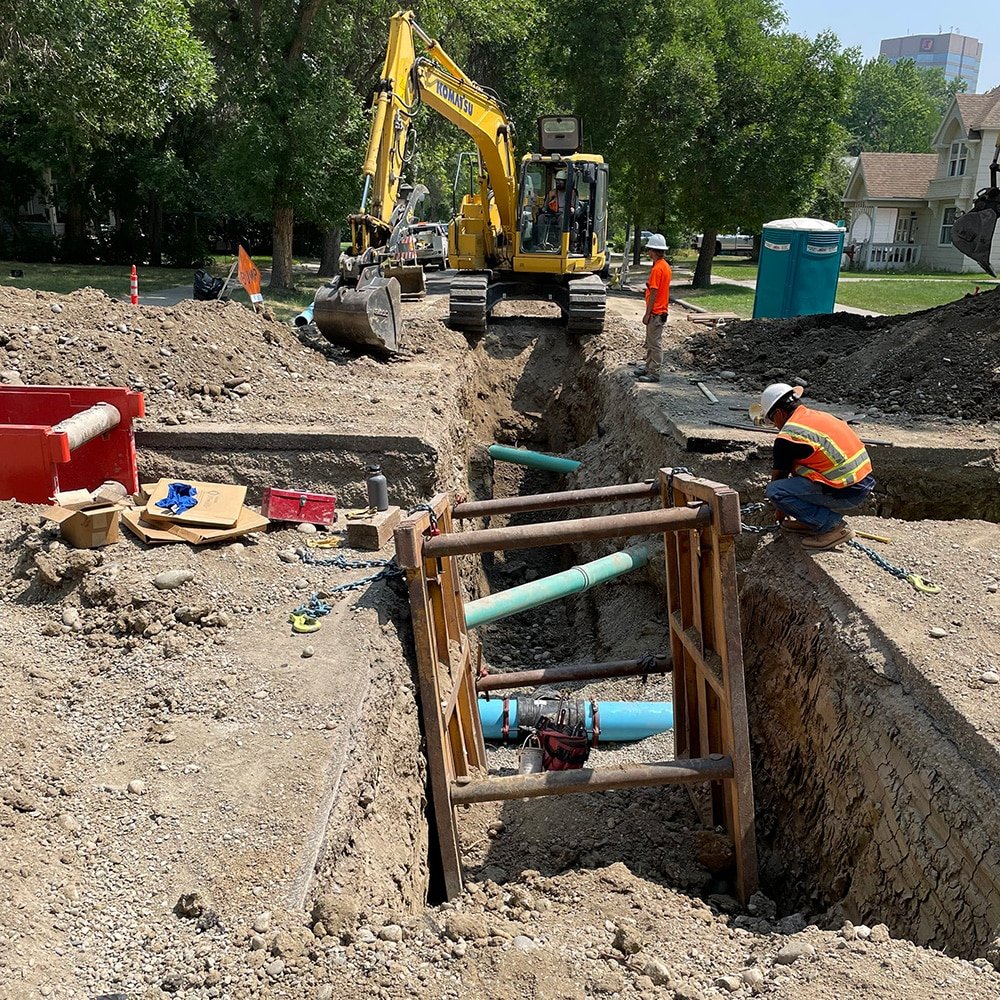
We start with line and grade. The pipe laser or grade stakes set the invert, and we verify depth of cover against the plans and the traffic loads above. Trench width is held to what the pipe and the bedding need, no wider. A trench box or sloped walls protect the crew, and spoil is kept back from the edge. Bedding is placed and compacted, the pipe is cleaned inside and out, and the joint is made according to the manufacturer's instructions. We plug the end of each day's run so mud and animals stay out.
Backfill is placed in lifts and compacted, because a badly compacted trench under a future drive or slab will settle. We take density tests as the specification requires. At crossings with sewer or storm lines, we maintain the required vertical and horizontal separation and tell the engineer if a field conflict makes the plan impossible to follow.
What the ground and the valley do to a pipe job
Parts of the metro lie in the Mesilla Valley with the Rio Grande to the west, and irrigation canals fed from the river by the diversion dam at Leasburg Dam State Park serve farms across the valley. Near canals and laterals, groundwater can be shallow in irrigation season, and we plan for dewatering when the trench bottom is wet. Our page on dewatering methods covers well points and sump pumping in more detail.
In open desert tracts, the issues are different. Long runs of pipe need to be hauled, strung and laid with little shade, and the work often crosses arroyos or future drainage paths. We bury the pipe below scour depth at drainage crossings and add protection where the plans call for it. We also locate existing lines and utility easements before we dig and call out any unknown pipe we find.
Trench safety and water quality
Trench collapse is the most dangerous thing on a pipe job, so every excavation deeper than the threshold gets a competent person, a protective system and an access ladder. We keep heavy equipment back from the edge and never let anyone work under a suspended load. Overhead power and buried lines are located before the machine moves.
Water quality is the second concern. Pipe and fittings are kept clean, open ends are capped, and trenches are dewatered before the line is laid. After installation, the line is flushed and disinfected following the owner's procedures. If a main is contaminated, it is re-flushed and retested until it passes. We do not skip steps to hold a date.
Where we install mains
Our water work covers Las Cruces, the valley communities along NM 28 and I-10, and industrial land near Santa Teresa and Sunland Park. We plan for the haul distances and mobilization costs that remote tracts bring, and we price them openly.
We work with municipal and public works owners, with utilities and energy companies and with private developers whose projects depend on service, including data center campuses where water supply is part of the cooling and fire protection design.
Plan the main before the building
If you are bringing water to a new tract, send the site plan and the point of connection. We will walk the alignment, price the extension with clear assumptions and tell you which permits and inspections will set the pace.
Questions Owners Ask
How deep does a water main need to be in this part of New Mexico?
Depth is set by the utility's standard and the plans, and it is usually based on cover over the pipe for traffic loads and other conditions. We follow the drawing and the owner's detail rather than a rule of thumb. If a utility crossing forces the main deeper or shallower, we flag it to the engineer before laying.
How long does a typical main extension take?
It depends on length, depth, pipe size and the number of tie-ins. A well-planned run can move quickly, but the schedule is driven by inspections, pressure tests and disinfection results as much as by trenching. We give a day-by-day sequence once we see the plans and the shutdown windows.
Do we need a hot tap or a shutdown to connect?
It depends on the owner's policy and the line size. Hot taps avoid shutting off customers but need specialized equipment and an experienced crew. Shutdowns are cheaper but have to be coordinated with the people who lose service. We bring both options to the owner with their trade-offs.
Can you work in an area with irrigation canals nearby?
Yes. We locate canals, laterals and gates before the survey crew finishes the alignment, and we keep access open for the people who manage them. Where a pipe crosses a ditch, we use the crossing method shown in the drawings and protect the pipe. Water in the trench is handled by dewatering during irrigation season.
What happens if a pressure test fails?
We find the leak, which is usually a joint, a fitting or a valve that was not fully closed, repair it and test again. We keep notes on where the pipe was exposed, since the first test often points to the problem. The owner's inspector sees the whole process, and nothing is accepted until it passes.