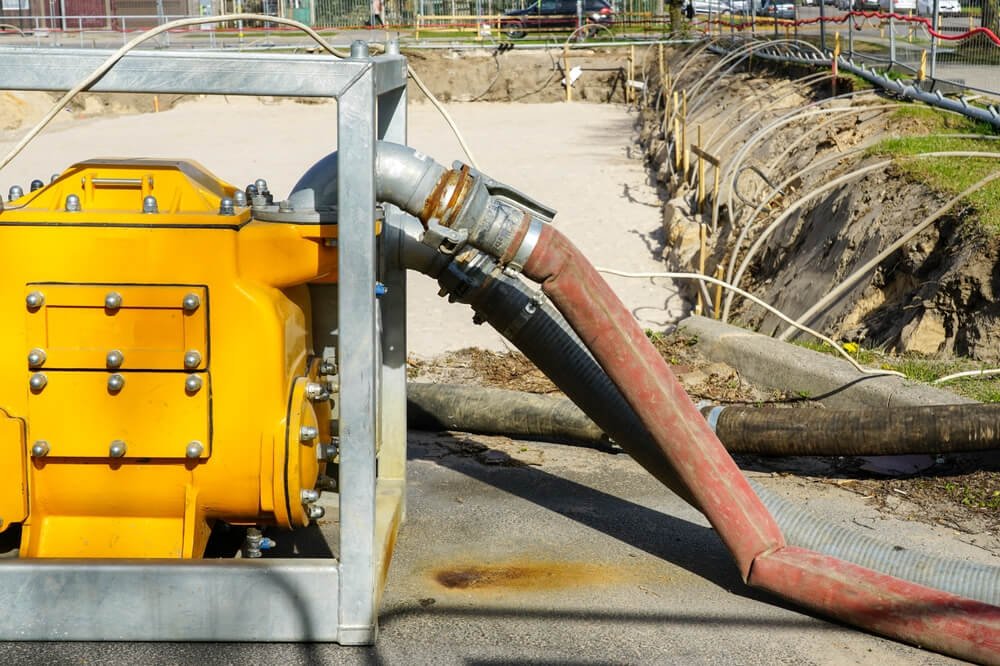
Dewatering for Excavations and Utility Trenches in the Mesilla Valley
Water in an excavation is never free. It softens the bottom, undermines the sides, floats pipe and wastes a day of crew time every time someone has to pump out before work can start. Dewatering is the plan that keeps the hole dry enough to build in, and it is much cheaper to make that plan before the excavator arrives than to improvise it after the first inch of water shows up.
The Mesilla Valley is where this matters most. Las Cruces sits at about 3,908 feet with the Rio Grande passing west of the city through the valley, Mesquite lies on the river's east bank with the river to its west, and Vado sits on the east bank as well. Parts of the valley are irrigated through ditches that divert river water, and around Hatch, farm irrigation draws on wells as well as surface water. Close to the river and the canals, groundwater can stand high enough to meet a deep trench or foundation excavation.
We plan and run dewatering as part of the excavation, with a clear idea of where the water comes from and where it goes.
Reading the water before we dig
The first question is where the water table sits and how it moves. The geotechnical report gives groundwater levels at the time of drilling, but levels change with irrigation season, river flow and recent rain. We ask the engineer for the seasonal range and compare the bottom of the excavation to the highest likely level. We also look at surface sources: canals, ditches, nearby ponds and the natural drainage path.
The second question is what the soil does when water moves through it. Clean, granular soils drain fast and need high-volume pumping. Fine soils drain slowly and can turn to mud. Mixed soils fall in between and can surprise a crew. We match the method to the soil, based on the report and on what we find during the first cut.
Sumps, well points and deep wells
The simplest method is a sump pump in a pit at the low point of the excavation. It works when inflow is small and the soils are stable. For trenches, we use well points, small pipes driven along the trench and connected to a header and a vacuum pump, to lower the water table ahead of the excavator. For deep foundations and large excavations, deep wells with submersible pumps lower the water table across a wider area.
We also handle the discharge. Pumped water must go somewhere that does not erode slopes, flood neighbors or carry sediment into a ditch or storm system. We run hoses or pipes to an approved location, add a settling area or filter bag, and keep records of the volume and quality as required. Foundations and deep utility work, such as those described on site excavation and trenching and backfill, are the main reasons we need these systems.
Wet trenches are dangerous trenches
Water weakens trench walls, so a protective system that works in dry soil may not work in wet soil. We review each trench with a competent person and adjust the sloping, shoring or trench box when water is present. We never allow anyone to work in a trench with standing water unless the competent person has cleared it and the water level is controlled.
Pumps, hoses and electric power on a wet site add their own hazards. We use ground-fault protection for electrical equipment, keep cords out of puddles and fence off open sumps. Fuel for pumps is stored with secondary containment, and spills are cleaned up immediately, since pumped water often goes to a place where fuel would be a problem.
Designing a system we can run and adjust
A dewatering system is rarely perfect on the first try. We start with a test, usually a few wells or a section of well points, and observe the drawdown. Observation wells or piezometers show how far the water table has dropped, and we adjust pumping rates and spacing based on what we see. The goal is to hold the water table below the work, with a margin, without pumping more than we need.
We keep the system running until the structure has enough weight to resist uplift. A pipe or a vault that is built in a dry hole can float if the pumps stop too soon, so we coordinate the shutdown with the engineer. We also watch for settlement of nearby structures, since lowering the water table can change the ground, and we monitor as the project requires. On a food and beverage processing facility with deep pits or trenches for process piping, this planning is part of the early design conversation.
What dewatering costs and how to control it
Dewatering cost follows the duration, the volume and the equipment. A small sump for a week is a minor line item. A well-point system around a long deep trench, running around the clock for months, is a major one. Fuel or power, labor to monitor, hose and pipe, permit fees and water treatment all add up. Owners sometimes find that dewatering becomes the most expensive part of the foundation, which is why we prefer to price it as a separate line.
The best savings come from timing and design. If the water table drops in winter after irrigation season, scheduling the deep work then may cut pumping cost. Shallower foundations or a different pipe alignment may avoid the water entirely. Agriculture and dairy owners near the river often have the best local knowledge of seasonal water, and we ask for it. Projects in Mesquite and Vado are good examples of sites that benefit from a seasonal plan.
Ask about the water early
If your site is near the river, a canal or an irrigated field, send us the geotechnical report and the depth of the deepest excavation. We will tell you what to expect from the water, which method fits and what it will add to the budget.
Questions Owners Ask
Do I need a permit to discharge pumped groundwater?
Often, yes, or at least an approval for the discharge location and quality. The requirement depends on the volume, the destination and the jurisdiction. We ask early and work with the owner and the engineer, because discharging to the wrong place can stop a job.
How deep can you dewater?
There is no single limit. Shallow sumps handle a few feet, well points handle roughly a dozen feet in a single stage and deep wells can lower the water table much farther. The choice depends on the soil, the depth and the budget.
Can dewatering damage nearby buildings?
It can, if it lowers the water table enough to cause settlement. We evaluate the neighbors, install monitoring points where needed and keep the drawdown only as deep as the work requires. The engineer sets the limits.
What if the water is contaminated?
We stop, document and notify the owner and the engineer. Contaminated water needs testing, treatment and approved disposal. It is not common, but when it happens, a clear record protects everyone.
Can you dewater in winter?
Yes, with attention to freezing. Hoses and pumps may need protection on cold nights. We plan for low overnight temperatures when they are forecast.