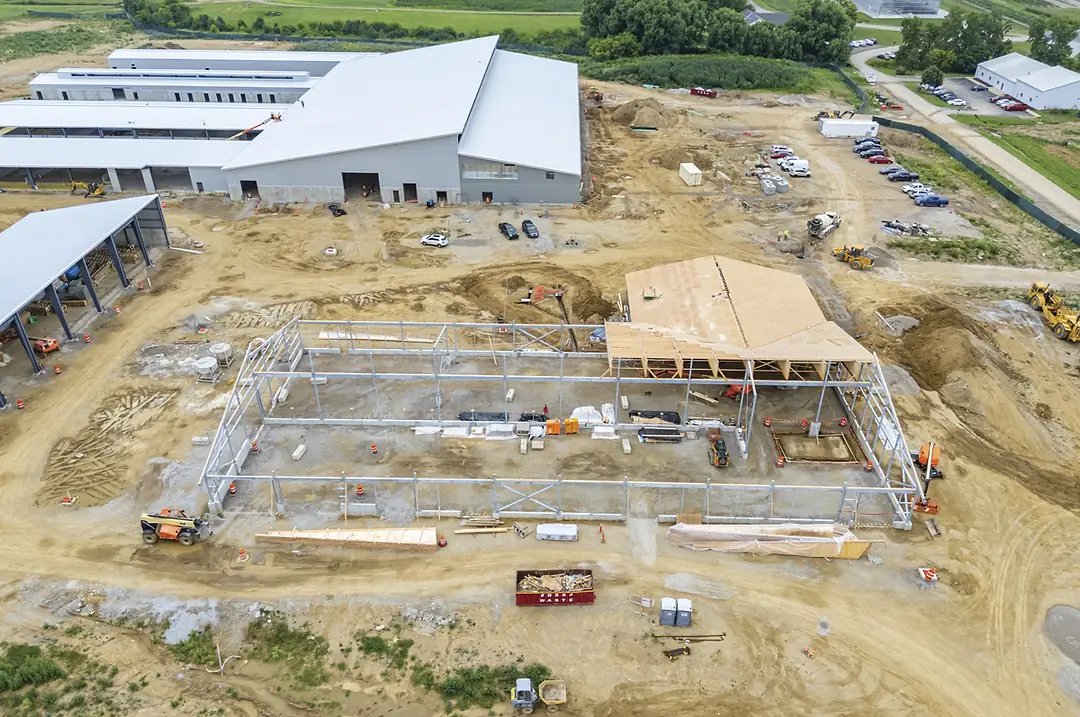
Concrete and Site Work for Agriculture and Dairy Operations in the Mesilla Valley
Irrigation season sets the calendar for almost everything built on a Mesilla Valley farm. Ditches carry water, crops need harvest access, and dairies milk through every holiday, so concrete and dirt work has to fit around the work that makes the money. We build for farmers, dairy operators, packers and ranchers who need pads, lanes, lagoons, ditch structures and roads that last, and who need us on and off the property fast.
The valley itself tells you what that means. NM 28 runs roughly parallel to the Rio Grande and passes farmland, dairy farms, vineyards and pecan orchards. Around Hatch, farm irrigation uses wells and surface water from ditches that divert from the Rio Grande and from Caballo Lake and Elephant Butte Reservoir, and the village is known worldwide for raising chiles. At the border, the Santa Teresa cattle crossing is the largest on the U.S.-Mexico border, with 534,245 head crossing per year, or 62 percent of animals crossed on the border.
We take the concrete and civil side of that economy seriously: floors that livestock can walk on, drainage that carries wash water away from feed, basins that hold wastewater, and pads that carry loaded trucks and equipment. This is how we plan and price the work.
A valley built on ditches, orchards and herds
The Hatch area shows how farm and village life are tied together, with 1,539 residents at the 2020 census and an annual chile festival each Labor Day. Farms here run on irrigation water that arrives in ditches on a schedule, and many farm buildings sit close to a ditch, a lateral or a drain. Building near them means grading that keeps water moving, culvert crossings that match ditch capacity, and pads that stay dry when the ditch is full.
Along NM 28, communities such as Chamberino, La Union and Anthony make up the agricultural corridor, and the cattle crossing at Santa Teresa adds yards, scales and truck staging to the picture. Agricultural owners often hire us for a mix of jobs in one season: a feed pad here, a loading ramp there, a headgate and a farm road crossing between them.
One schedule for the dirt, the forms and the finish
Farm projects rarely justify three subcontractors, and rarely have time for the handoffs. We coordinate the dirt work, forms and rebar, concrete placement and finishing and pipe installation on the same job. A dairy lane starts with a graded and compacted base, gets formed to the slope the engineer drew, and is poured and textured under the same supervision that checked the grade.
That continuity matters for animal housing. A feed alley or holding pen has to drain in the right direction, give cattle traction and resist the chemical attack of manure, urine and wash water. We use low water-cement ratio mixes, textured finishes and sealed joints, and we cure carefully so the surface hardens before animals use it.
Floors, lanes, lagoons and ditch structures
Our agricultural scope covers the structures and surfaces that live, work and drain around animals and crops. For dairies that includes milking parlor floors, holding areas, feed alleys and flush lanes, wash pads, silage and commodity pads, and manure handling slabs. For orchards and packers we pour processing floors, cooler pads and truck docks, and for chile and pecan sheds we build wash-down slabs with drains. Food and beverage processing standards apply wherever product is handled for sale.
On the dirt side, we dig and shape ponds and basins for wastewater and stormwater, and we install culverts and headwalls where roads cross ditches. We also build farm roads with compacted base that handle loaded trucks without rutting, and we reshape drainage paths so water finds the ditch, not the barn.
Working around irrigation, harvest and milking
We schedule around the farm. Ditch crossings are planned for dry periods or built in sections so flow is not interrupted for long. Harvest sets its own hard dates; a pecan or chile grower cannot lose access to a field when the crop is ready. A dairy cannot stop milking, so we pour in sections, maintain cow traffic and release each lane back to the herd once it has cured.
Summer is hot, with June highs averaging 96.2 degrees F in Las Cruces, so we start early, protect fresh concrete from sun and wind, and keep water on hand for curing. When storms build in the afternoon, we cover and stop rather than risk washing the surface.
Permits, easements and ditch rights
Agricultural buildings and structures still involve permits, though the details depend on use. Grading near drainage, new driveways onto a state road and wastewater basins can each need approval, and the owner or the engineer typically leads that process. We prepare the construction submittals and coordinate inspections that apply.
Ditches carry their own rules. An irrigation district controls its right of way and decides how and when a crossing may be built, and a bore under a canal is treated differently from an open cut in a lateral. We ask for the district's requirements before we price, and we respect its water schedule. Utility service to a new dairy or packing shed involves utilities and energy companies, and getting their clearances early prevents delays.
What drives the price of farm and dairy concrete
Quantities are the first driver: a feed lane or milking parlor floor can involve hundreds of cubic yards, and a lagoon involves thousands of cubic yards of dirt. Haul distance matters too, since farms are often miles from a batch plant, and remote jobs add mobilization and delivery time. Durable mix design, joint sealants and textured finishes add cost, but they pay back on surfaces that livestock and equipment attack every day.
Dirt work can be the swing item. If the soil is suitable and balanced on site, a basin or pond can be built with minimal haul-off, while unsuitable material adds cost. We also compare layouts with logistics and warehouse developers when a packing or cold-chain building shares the site, since truck circulation and dock aprons drive concrete there as well.
Tell us about the farm
Share the location, the work you have in mind and the dates you cannot lose, such as harvest or irrigation turn-on. We will return a plan and price that respect both.
Questions Owners Ask
Can you pour around an operating dairy?
Yes. We pour in sections, keep animal routes open and plan cure times so each section is ready before cows return. We coordinate with the herd manager on milking times and feeding schedules and keep equipment away from animal traffic.
What surface works best for cattle traction?
Most feed alleys and lanes get a textured or grooved finish that gives hooves grip without chewing hoof or hide. The pattern and depth depend on the engineer's design and the animal group. We place test sections if the owner wants to review before the full pour.
How do you build a wastewater basin?
The engineer sets depth, side slopes and any liner. We excavate, shape and compact the sides, install the liner if required, and place inlets, outlets and fencing. We separate good soil for berms and haul only what has to leave.
Can you work near a ditch while it is carrying water?
We avoid it where we can, scheduling ditch crossings and structure work for dry periods agreed with the irrigation district. When we have to work beside flowing water, we protect the channel with temporary barriers and keep sediment out of the stream.
Do you handle farm road and truck pad construction?
Yes. We build compacted base roads and heavy-duty concrete pads for feed trucks, milk tankers, grain trucks and packing operations. Pad thickness depends on the loads and the soil.