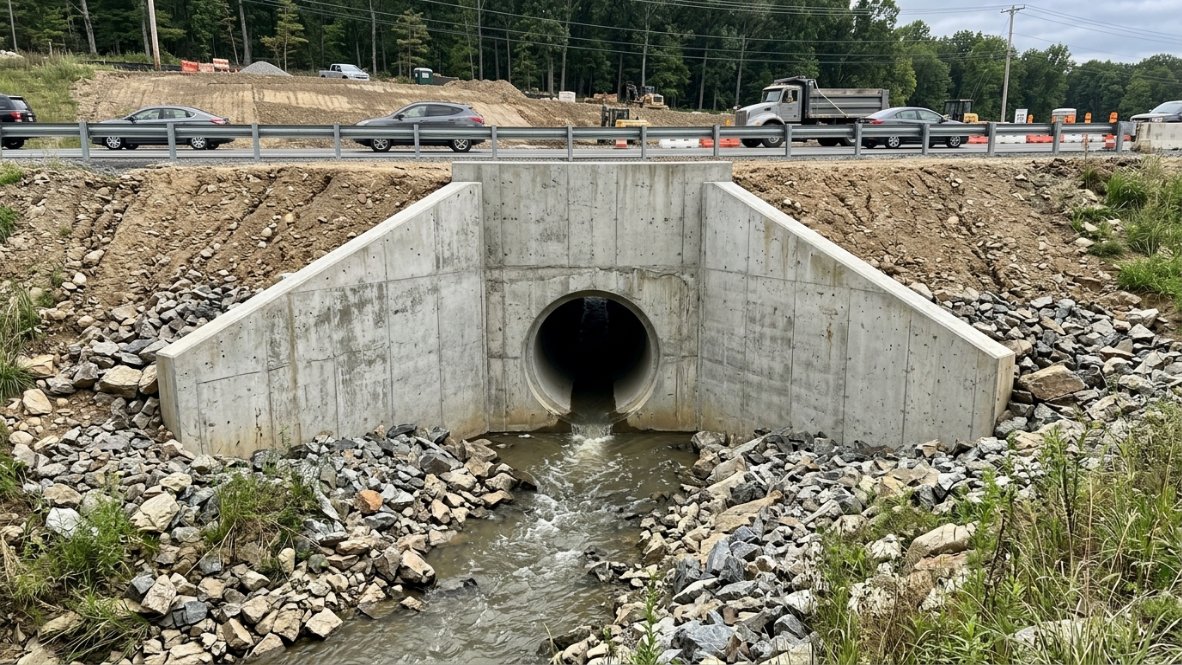
Culverts and Headwalls for Roads, Drives and Arroyo Crossings in Las Cruces
Dry washes are only dry until they are not. Around Las Cruces, the arroyos are dry streams that often carry water after heavy thunderstorms, and any road, drive or pad that crosses one is relying on a culvert to move that water without washing out the fill above it. We build the pipe, the concrete ends and the protection that keeps them in place.
Culverts matter even at the edge of the metro. Organ sits in the southwest foothills of the San Augustin Mountains, where US 70 crosses San Augustin Pass, and Radium Springs lies at the upstream end of the Mesilla Valley beside the Rio Grande, below a diversion dam that sends water into canals serving valley farms. Drainage, canal crossings and irrigation structures all depend on the same simple elements: a well-bedded pipe or box, a solid headwall and a good plan for what happens to the water on the other side.
This page explains how we build them, what the inspector wants to see and where the cost hides.
Where culverts show up in this metro
Road projects and private drives are the obvious places. A new frontage road, a truck entrance or a ranch road that crosses a swale needs a culvert, sometimes a row of them. Developers also put culverts at the edge of detention basins and under internal drives, where they carry flow from one pond to the next. Along canals and laterals, culverts pass irrigation water under farm roads, and these are often the oldest and most fragile.
The terrain adds variety. In the foothills, flows are steep and fast and carry gravel and boulders, so culverts need bigger inlets and tougher protection. In the valley floor, slopes are gentle and water spreads out, so the issue is more about maintaining capacity and avoiding sediment buildup. We tailor the design details to each setting, working from the engineer's drawings.
Pipe culverts, box culverts and concrete ends
Our culvert scope includes excavation, bedding, pipe or box placement, joints, backfill, headwalls, wingwalls, aprons and rock riprap. We set reinforced concrete pipe, corrugated metal pipe, plastic pipe and precast boxes according to the plans. Headwalls and wingwalls may be precast or cast in place, and we coordinate the latter with the forms, rebar and concrete trades. Formwork practices follow what we describe in concrete formwork.
Details matter at the ends. The pipe has to project or be cut flush as drawn, the headwall has to key into the soil, and the apron has to extend far enough to keep the pipe from being undermined. We also place cutoff walls or toe-downs where the plans call for them, because scour at the outlet is the most common cause of culvert failure.
Scour, sediment and what happens during a flash flow
A culvert fails when the water finds the weak point. Scour at the outlet, piping along the pipe and overtopping of the roadway are the usual mechanisms. We reduce those risks by compacting bedding and backfill carefully, sealing joints, placing riprap and filter material per the plans and building the headwall tall enough to retain the embankment. If we see a design that looks light for the flow, we ask the engineer before we build it.
Sediment and debris can also block a culvert. Trash racks, debris deflectors and a clear approach channel help. During construction, we keep the channel open and clean, and we avoid stockpiling soil where a storm can wash it into the pipe. In a washed or active arroyo, we plan a diversion or a low-water crossing to handle flow while the culvert is being built, as discussed in our detention and retention ponds work.
Building crossings in the dry window
Most culvert work is best done when the channel is dry, so we plan around the monsoon season. A crossing started in late spring can usually be finished before the summer storms; one started in July may need a bypass plan. We keep an eye on the forecast and stage the work so the excavation is not left open overnight when storms are likely.
Precast culverts and headwalls come from the plant on a lead time, so we order early and verify dimensions. Cast-in-place work needs time for curing before backfill, with the engineer's guidance on minimum strength. We build these steps into the schedule, with float for weather, and we coordinate with the road or pad contractor who is waiting on the crossing.
Drainage approvals and road standards
Culvert crossings are reviewed with the drainage plan. Design flows, pipe size, headwater depth and outlet velocity are set by the engineer, and the reviewing agency checks them. For crossings on public roads or canals, an additional permit and sometimes an inspector are needed. We keep the permit on site, call for inspections at bedding, pipe set and backfill, and we document the as-built invert elevations.
Where a culvert crosses an irrigation ditch or lateral, the ditch owner has a say. We coordinate with the owner about the dry window, the crossing details and the access they need to run water. For work on state routes or federal land, additional requirements may apply, and we help owners confirm them early.
How culverts link to roads and pads
Culverts live inside larger projects. A drive crossing needs road subgrade preparation on both sides, and the pipe depth sets the thickness of cover under pavement. A pad near a wash may need the culvert before the fill is placed. We often build the crossing as part of the first earthwork phase, so the rest of the site has dry access.
We serve oil, gas and midstream owners who need access roads across drainage, and developers who need to cross natural washes with internal drives. In both cases, communities such as Organ and Radium Springs show how varied the terrain can be even within a short drive.
Walk the crossing with us
Send the drainage plan or just tell us where the water crosses. We will look at the crossing, review the design and propose a sequence that keeps the work in the dry window.
Questions Owners Ask
How do you size a culvert?
The engineer sizes it using the design flow, the allowable headwater and the outlet conditions. We build to those dimensions. If the field shows a larger channel or heavier flow than expected, we raise it with the engineer before installing a pipe that may be too small.
Is a box culvert better than round pipe?
A box culvert is wider and shallower, which helps where cover is limited or flow is wide. Round pipe is easier to install and often cheaper. The choice is made in design, and we can price both for comparison.
What is a headwall for?
It holds back the embankment, directs flow into the pipe and protects against erosion at the ends. Wingwalls extend the headwall at an angle, and aprons protect the channel floor. Without them, the pipe ends can undermine and fail.
Can you replace an existing culvert without closing the road?
Sometimes, by building a temporary detour, working in halves or using a trenchless method. The right approach depends on the road, the traffic and the permit. We review the options with the owner and the agency.
How long does a typical culvert crossing take?
A simple pipe crossing may take a few days. A large box culvert with cast-in-place headwalls can take several weeks. The curing time, the inspections and the weather all affect the schedule.