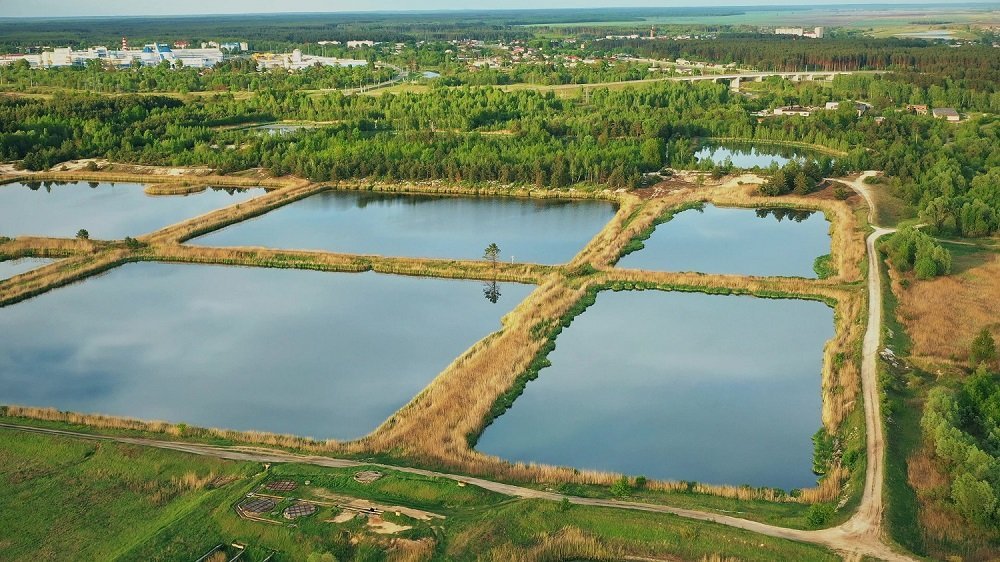
Detention and Retention Ponds for Las Cruces Developments
Most of the year, a detention pond holds nothing at all. Then a summer thunderstorm hits a parking field with more water than the ground can take, and the basin has to take it in, hold it and let it out at the rate the engineer drew. The entire value of the structure comes from performing correctly a few times a year, which is why we build ponds with the same tolerances as the buildings they protect.
Big sites mean big basins. The City of Las Cruces lists more than 400 acres of its Innovation and Industrial Park as shovel ready, and Santa Teresa has a 1,100 acre Gateway Rail Park. Every roof, truck court and trailer lot on land like that sheds water the desert used to absorb, and somebody has to hold it. Basin volume, outlet size and spillway elevation are decided in design, but the quality of the dirt work and the outlet structure decides whether the design actually works.
We build detention and retention basins from the first cut to the final seeding.
Why basins are part of every large site here
Detention slows runoff and releases it at a controlled rate, and retention holds water until it infiltrates or evaporates. Which one a site needs depends on the downstream system and the local drainage rules. In the Las Cruces area, arroyos that are dry most of the year can carry strong flow after heavy storms, and a development that sends unmanaged runoff into one makes the next storm worse for everyone downstream.
Flat land complicates matters. Deming, at 4,331 feet, notes that minor flooding sometimes occurs over large areas of flat ground. On low-relief sites, a basin may need to be wide and shallow, with a long outfall path, rather than deep and compact. We look at the full flow path from the site boundary to the discharge point before we settle on how the basin will be built.
Soils, side slopes and the long dry spells between storms
The soil in the bottom of a retention basin decides how fast it drains. Fine soils drain slowly, sandy soils quickly, and a compacted floor drains hardly at all. We keep equipment off the basin floor after the final cut, because traffic compaction can ruin infiltration. If the plan calls for a lined basin, we prepare the subgrade, install the liner and cover it as specified.
Slopes are the other issue. Side slopes must be stable when wet and when dry, and they need vegetation or armoring to resist erosion. Between storms, which can be months apart, wind and heat can strip bare slopes. We plan seeding or rock cover, temporary erosion controls and a watering plan so the basin is stable before the first flow. Our erosion control and SWPPP work is closely tied to the basin schedule.
Excavation, embankments and outlet works
The excavation produces a lot of soil, and handling it is half the job. We cut the basin to the design grades, stockpile suitable material for embankments or building pads and haul the rest away, following the principles laid out in our work on pond and basin excavation. Embankments are built in lifts and compacted to the specification, with testing as required.
Outlet works include the control structure, outlet pipe, orifice or weir, trash rack and emergency spillway. These are usually concrete structures set at exact elevations, and we build them in the order that lets the earthwork proceed. Inlet protection and energy dissipation at pipe outfalls complete the system. If a headwall or an endwall is needed, our work on culverts and headwalls covers the same details.
Design criteria, approvals and as-built certification
Basins are reviewed by the local drainage authority and may need approval before the grading permit is issued. The review looks at volume, release rate, freeboard, side slopes and emergency overflow. After construction, the engineer usually certifies the as-built volume and outlet elevations, which means we must hit the grades. We therefore survey the basin at key stages and give the engineer the data before the final cut.
Safety around ponds is also considered at design. Slopes, fencing and access are set by the plans, and we build them as drawn. We provide maintenance access ramps for the owner, because a basin that cannot be reached for cleanout is a basin that will fail.
Where the money goes in a basin
Volume is the main driver. Moving soil costs money, so cost follows cubic yards, haul distance and disposal. If the soil can be reused on site for fill, the net cost drops. A basin that supplies dirt for a building pad can effectively pay for itself, which is why we examine the earthwork balance of the whole site before pricing the basin alone.
Outlet structures, liners, rock armor and landscaping add cost. Dewatering, if groundwater is high, is another. For logistics and warehouse developers, basins often take up a large share of the site, so a modest saving in grading can free up space for another building. We help owners compare basin shapes and depths with this in mind.
Building a basin that performs
We start with survey control and a plan for the earthwork. The topsoil is stripped and stockpiled, the basin is cut in stages and embankments are built in lifts. Compaction testing proceeds as the specification requires. Outlet structures are placed as soon as the grade allows, so they can be checked before the basin is shaped around them.
At the end, we shape the basin, finish slopes and apply the specified stabilization. The last step is a walkthrough with the engineer to check the volume, the outlet elevations and the inlet protection. For work around Santa Teresa and distribution sites such as a distribution center, we often build the basin early so it can serve as a sediment trap during the rest of construction.
Where we build ponds
We work across southern Dona Ana County, the Mesilla Valley and the outlying areas where large parcels are available. Haul distances, access and disposal sites differ from one area to another, and we plan for those. Sites near Deming and other flat parts of the region often need larger basins and longer outfalls.
Many projects include several small basins rather than one large one, which can reduce the depth and the cost. We evaluate each option with the engineer and show the owner the trade-offs.
Bring us the drainage report
Send the drainage report and the grading plan and we will estimate the earthwork, the outlet structure and the stabilization. An early look at the basin often shows ways to save on the rest of the site, and we are glad to talk through it with you.
Questions Owners Ask
What is the difference between a detention pond and a retention pond?
A detention pond holds stormwater temporarily and releases it at a controlled rate through an outlet. A retention pond holds water permanently or until it infiltrates or evaporates. Which one you need depends on the drainage rules and the downstream system. We build both.
How long does it take to build a large basin?
The earthwork is often a few weeks to a couple of months, depending on volume and equipment. The outlet structure and the stabilization add time. We schedule the basin early so it can serve the rest of the project.
Can the basin soil be used elsewhere on the site?
Often, if it meets the specification for fill. We test the soil and plan the balance so that cut from the basin goes to pads and roads. That can reduce haul-off and import costs.
What happens if the basin holds water longer than designed?
Slow draining can come from compaction of the floor, fine soils or a clogged outlet. We investigate and propose a fix with the engineer, which might be ripping the floor, adding drain lines or cleaning the outlet.
Do ponds need fencing?
That depends on the design and the owner. Many basins are shallow with gentle slopes and do not need fencing; deeper ones may. We build what the drawings show.