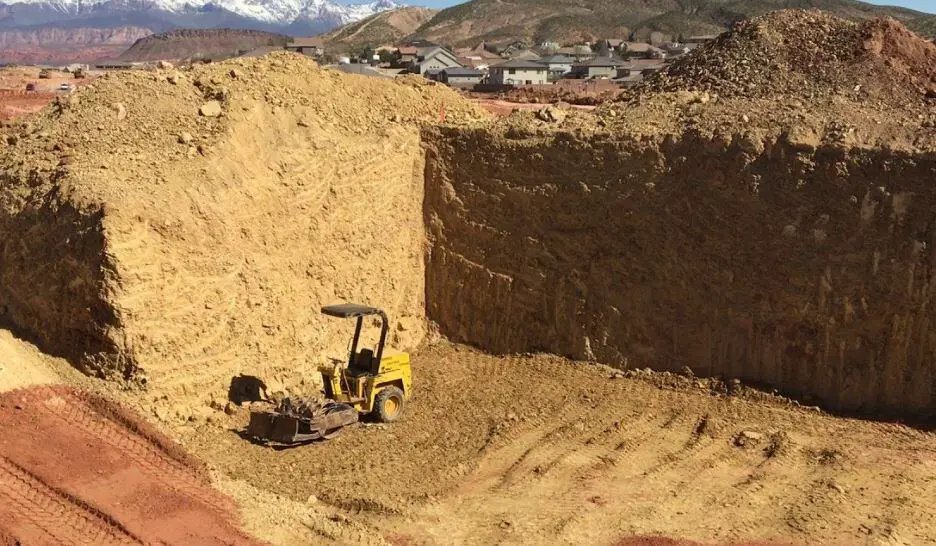
Over-Excavation and Recompaction Under Slabs and Pavements in Las Cruces
Soft ground is cheapest to deal with on the day you find it. Over-excavation is the removal of poor or disturbed soil below a planned grade, and recompaction is the placement of controlled, tested fill to bring the area back up. Both happen under foundations, slabs, pavements and utility structures where the soil has to carry load, and both go better when the decision is made at the bottom of the cut with the engineer standing next to us, not months later when a slab has cracked.
Flat ground in this region does not always drain the way it looks. Deming records minor flooding over large areas of flat ground at times, and the arroyos around Las Cruces often carry water after heavy thunderstorms, so a parcel can be wetted unevenly and leave soft zones that were not obvious when the borings were drilled.
We do this for developers and general contractors who have a geotechnical recommendation to remove and replace a set depth of soil under a building, and for owners who find a surprise during grading. The work sits between building pad preparation and engineered fill in a typical sequence.
How a recommendation becomes a dig
A geotechnical report often recommends removing a set depth of existing soil below footings or slabs and extending the cut a set distance past the edge of the structure, so loads spread into good material. Those recommendations are only as good as the borings, which sample a handful of points on a large site. We treat the report as the starting point and keep the engineer involved at the bottom of the excavation, where real conditions are visible.
The extent matters as much as the depth. The cut is usually wider than the footprint, which means more volume, more haul and sometimes a property line problem. We measure and mark the limits before digging, confirm them with the project team and raise any conflict with adjacent utilities or structures right away. Where an area would need weeks of drying or wetting to be workable, we tell you that up front instead of discovering it mid-schedule.
Removal, proof-rolling and replacement
The work has four parts: strip the unsuitable soil to the depth and limits shown, proof-roll and inspect the exposed bottom, scarify and recompact the surface if the engineer asks for it, and then rebuild with fill in thin lifts. The replacement fill may be the same soil after drying or wetting, imported select material or a stabilized mix, depending on the report. Each lift is tested before the next is placed.
Proof-rolling is how we find what the borings missed. A loaded water truck or heavy roller crosses the exposed bottom under the engineer's eye, and anything that pumps, ruts or rebounds is marked. Those areas are cut deeper and replaced, then proof-rolled again. The result is a bottom the engineer can accept on evidence rather than on a boring log alone.
Buildings that depend on a recompacted pad
Large slabs are the most sensitive. A distribution center floor carries racking and forklift traffic across a big area, so differential settlement shows up quickly as cracks at joints and doors that no longer seal. Over-excavation under such a floor is common when the soil report finds loose or collapsible layers at shallow depth, and fixing it before the concrete is a small fraction of the cost of fixing the floor.
Smaller structures use the same method. Utility vault bases, detention structure foundations, light pole bases and canopy footings in parking lots benefit from a controlled bottom as well. We scale the effort to the load: a vault base may need a foot or two of select material, while a heavily loaded floor needs a much deeper replacement. Our job is to tell you which is which, verify it with concrete and soil testing and show you the results.
Working on unstable ground
Soft or wet ground brings equipment risks along with the digging ones. Machines can bog down, tip at the edge of a deep cut or slide on a wet slope, so we keep haul routes on firm ground, use mats or stabilized aggregate where needed and cut walls back to a safe angle. A spotter works the area whenever trucks load near an open pit.
Dust is the other hazard in dry weather, since removed material dries fast and the wind picks it up. We wet the cut and the stockpile, hold haul speeds down and stop work if visibility drops on the nearby road. Where removed soil looks contaminated, we stop and notify the owner before it leaves the site, because disposal of that material is a regulated matter and not ours to decide alone.
Where the money goes in a remove-and-replace
Depth and area give the volume, and volume drives cost: removal, haul-off, replacement material, hauling it in and compaction all scale with it. Replacement material is often the biggest line, because imported select fill costs more than native soil and has to be trucked in. Testing frequency and the time the lab takes to turn results add to the schedule.
We handle uncertainty by pricing a base quantity from the geotechnical report and a unit rate for additional depth or area found during excavation, so you are not exposed to a blank check or asked to guess. Commercial developers usually want that unit rate in the contract, since the final number depends on what the proof-roll finds.
Making the repair last
What makes a recompacted area last is consistency. We place fill in lifts of uniform thickness, bring each to the moisture range the report calls for and compact with equipment sized to the material. Edges and corners get as much attention as the middle, because that is where weak spots form. Every lift is tested at the frequency the specification sets, and failing spots are reworked immediately.
We also protect the finished area. A recompacted pad that sits exposed through a monsoon can lose moisture content or soften, so we sequence the work to be followed closely by forms or base course and keep traffic off it. When delays are unavoidable, we reshoot, re-roll and retest before releasing the area. When the soil itself should be altered rather than replaced, we turn to lime and cement soil treatment.
Found soft ground?
Send the boring logs and the geotechnical recommendation, or call us from the site. We will walk the cut with your engineer and give you a base price and a unit rate for extra depth.
Questions Owners Ask
How do you decide how deep to over-excavate?
The geotechnical report gives a recommended depth, and the engineer confirms it at the bottom of the cut after the proof-roll. We dig to the recommendation, then deeper only where the proof-roll shows soft or pumping ground. Extra depth is paid at the unit rate in the contract.
Can the removed soil go back as fill?
Often yes, if it can be dried or wetted to the right moisture and it meets the specification. Otherwise it is hauled off and replaced with select material. We sample and test before deciding, so material is not trucked away that could have stayed.
How long does a typical remove-and-replace take?
Digging goes quickly. Drying or wetting soil, placing lifts and waiting on test results set the pace. For a building-sized area it is usually days to a couple of weeks, depending on depth and weather. We give a lift-by-lift schedule with the proposal.
What happens if the lab fails a lift?
We scarify the lift, adjust moisture, recompact and retest, and nothing goes on top until it passes. Placing the next lift over a failed one hides the problem and costs far more to fix later.