Lime and Cement Soil Treatment for Pavements and Pads in Las Cruces
Quicklime is hot, dusty and caustic, which is why the first thing we talk about on a lime job is wind. In Las Cruces, spring afternoons can be windy with blowing dust, and a plume from a spreader drifting onto a neighbor or a road is a problem no mix design solves. Lime and cement soil treatment mixes a measured amount of reagent into the soil in place so that weak, wet or plastic material becomes a firm working platform and a stable subgrade, and the result depends as much on the day we choose as on the product we use.
Treatment is worth considering when the native soil cannot carry the load you plan to put on it and importing replacement is expensive. A few percent lime or cement by dry weight, blended to depth and compacted within the working window, can turn a rutting subgrade into one that supports a truck court, a paving train or a building slab. The laboratory sets the mix, and we follow it.
We treat soil for developers and contractors building pavements and pads, from streets for homebuilders and multifamily developers to heavy yards. Treatment also works alongside engineered fill, and which one goes where is a design decision we talk through with the engineer.
What a treatment job includes
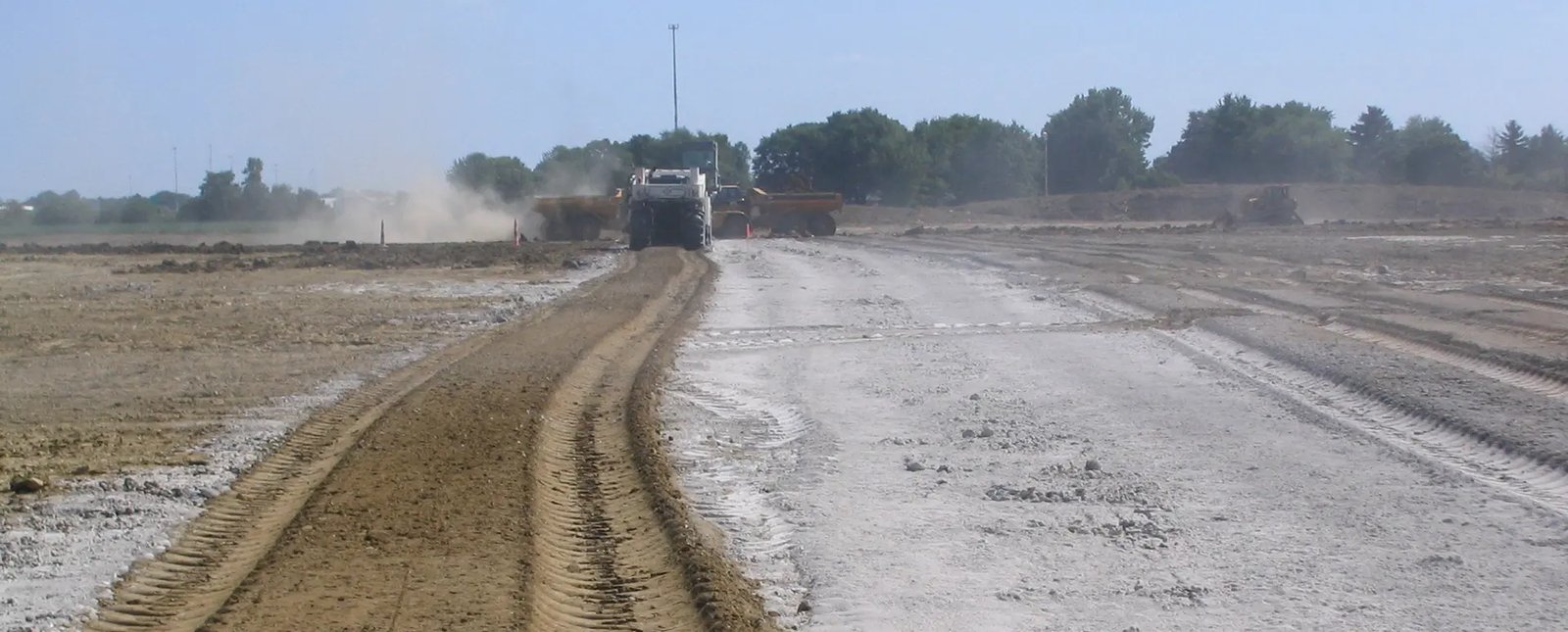
The sequence is to strip and shape the surface, proof-roll, spread the reagent at the rate from the mix design, mix to depth with a stabilizer or reclaimer, add water, compact, trim and cure. Lime jobs often use a mellowing period between the first mixing and final compaction so the reaction can proceed, and that can run a day or more. Cement jobs are faster, with a short window between mixing and compaction because the cement begins to harden.
We also handle the less glamorous parts: staking the application areas, calculating tons per area, checking spread rate with pans, taking samples to confirm the depth of mixing and getting the lab to verify strength or plasticity. The scope should state who supplies the reagent, who tests, how long the cure period is and who protects the surface until base or paving is placed.
Handling reagents around people and traffic
Lime and cement irritate skin, eyes and lungs, so crews wear eye protection, gloves, long sleeves and respiratory protection as the product label requires, and washing facilities are on site. We keep spreaders and mixers sized to the area and run them only when the wind is low enough that product lands where it is meant to. If the wind picks up, we stop spreading and mix what is already down.
Neighbors and traffic get protection too. We pre-wet where the specification allows, use slurry application when dust is a concern near occupied buildings and keep spread and mixing equipment off public roads. Runoff from treated areas is alkaline, so it is kept out of storm inlets and channels. The product safety data sheets stay on site with the crew.
Mixing to depth and compacting in the window
Uniform mixing is the whole game. A stabilizer or reclaimer passes in overlapping lanes, cutting to the specified depth, and we verify depth by digging test holes and checking against the plan. Moisture is adjusted during mixing, since both lime and cement need water to react, and we compact with rollers matched to the treated material.
The clock matters most with cement. From the moment cement meets water, the mix has a limited time before hardening begins, so we never mix more than the roller can finish. After compaction we trim, seal with a light water spray or an emulsion and keep traffic off until the layer has cured. Where the treated layer will be capped, we confirm the cure with the engineer and coordinate the handoff with asphalt paving base preparation.
Is treatment the right answer for your soil?
Not every soil likes lime or cement. Clays respond to lime, sandy and low-plasticity soils tend to respond better to cement, and some soils carry sulfates or organics that can interfere with the reaction. The geotechnical report and a laboratory mix design tell us which route to take. Our part is to flag a doubtful result early, before a large area has been treated.
Scale matters as well. A very small area may be cheaper to remove and replace, while a long street or a truck court saves real money when treated in place. Heavy yards such as a truck terminal and cross-dock make the case clear, because the pavement section depends on the strength of what lies beneath. A border industrial association presentation lists the Santa Teresa intermodal terminal with 1,266 container and trailer parking stalls expandable to 4,380, and a revised annexation proposal in Sunland Park covers roughly 362 acres, so large paved areas are part of this metro's future.
Choosing the day and protecting the cure
Treatment is weather sensitive. We avoid spreading in strong wind or rain, and in summer we start early so mixing and compaction finish before afternoon heat dries the surface. Las Cruces averages about 9 inches of precipitation a year, so dry days are the rule, but when a storm does arrive it can ruin an unprotected treated area that has not been compacted.
Cure time belongs in the schedule. Lime-treated layers gain strength over days and weeks, and cement-treated layers gain strength faster but still need protection from traffic and drying. We work with the general contractor to hold paving or slab placement until the engineer is satisfied and to route construction traffic away from fresh work, so that a treated subgrade can become the platform for concrete paving without a detour.
Weak subgrade on your site?
Send the soils report and the pavement or slab section. We will talk through whether lime, cement or replacement fits, and price the one that does.
Questions Owners Ask
How do you know whether to use lime or cement?
The geotechnical report and a laboratory mix design decide. Lime generally suits clayey soils and cement suits sandy or low-plasticity soils. The lab tests several reagent rates and reports the strength or plasticity change, and we use the rate that meets the target.
How deep can soil be treated?
Commonly in layers of several inches to a foot or more, depending on the equipment and the design. Deeper treatment is built up in lifts. The depth on the plans is the depth we mix, and we check it with test holes.
Can you treat soil in windy weather?
We prefer not to. Wind carries dust off the spreader, which is a safety and nuisance problem. In windy periods we hold the spreading, switch to slurry application where allowed or work in calmer hours and mix what is already down.
How long before treated ground can take traffic?
That depends on the reagent and the specification. Cement-treated layers firm up within a day or so but still need a cure period, and lime-treated layers need longer for the reaction to build strength. We keep construction traffic off until the engineer confirms.