Electrical Duct Banks in Las Cruces and Dona Ana County
Power reaches a building through sand, spacers and concrete long before it reaches it through wire. A duct bank is a buried bundle of conduits, held at exact spacing and often encased in concrete, that has to carry traffic over it for the life of the building and still allow cable to be pulled through it. We treat it as a structural element, not as a trench with some pipe in it.
The demand for this work is coming from the biggest projects in the metro. Project Jupiter, a 1,400 acre data center under construction in Santa Teresa, is the clearest example of a site where power distribution is the main event. Closer to the city, utilities, lighting and taxiways were extended on the east side of Las Cruces International Airport to support hangar development, and any site with new buildings and lighting needs a buried electrical backbone.
We build duct banks for owners, general contractors and electrical contractors, and we coordinate closely with the people who will pull the cable.
Why duct banks are showing up on more site plans
The Las Cruces area has several large sites under development at once. The city has more than 400 acres of its industrial park listed as shovel ready, and large industrial users need medium-voltage feeders, transformer pads and distribution to buildings, none of which can be installed without a well-planned conduit system. When the project is a data center or a manufacturing plant, the electrical load defines the layout of the whole site.
Duct banks also appear on airport work, where taxiway and apron lighting circuits run beneath pavement and are expected to last through years of heavy loads. In every case, the lesson is the same: build the conduit before the paving, because cutting an existing slab to add a duct is slower and more expensive than building it right the first time.
Conduit, spacers, encasement and pull points
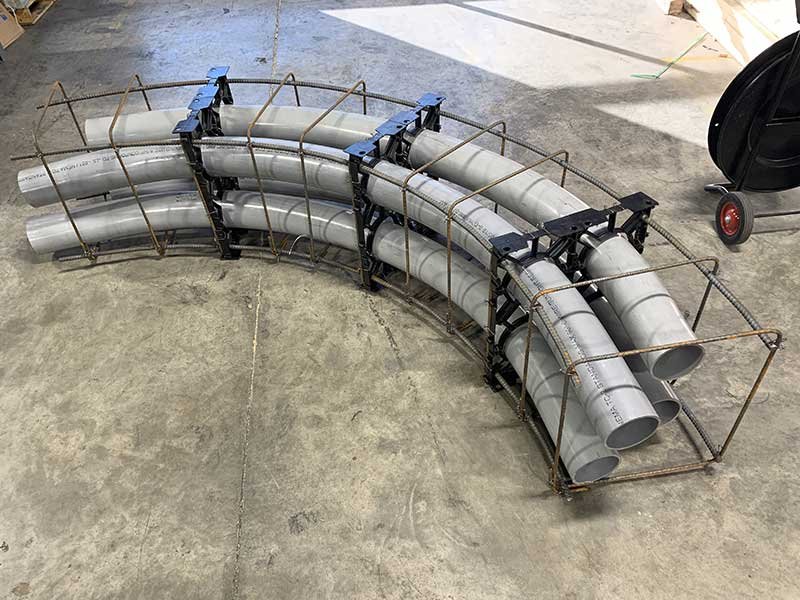
A duct bank starts with the layout. The electrical drawings show how many conduits are needed, their size and their burial depth, and the civil drawings show where they cross other utilities. We excavate to line and grade, set the base, place spacers at a regular interval, assemble and glue the conduit, and tie the bank down so it does not float when the concrete is placed. We then place sand or concrete encasement as specified, usually with a red dye so future excavators know power is below.
Pull boxes, handholes and manholes are part of the system. Our work on manholes, vaults and structures covers the precast and cast-in-place boxes where cable is pulled and spliced. At each box, conduits enter at the right height and angle, with bell ends and bushings to protect the cable. We also build the transformer and switchgear pads that the duct bank leads to, which is covered under equipment pads and machine foundations.
Why we manage the trench, the forms and the concrete together
A duct bank touches three trades: excavation, forming and concrete. When we manage all three as one scope, we do not wait for another company to arrive. The trench is dug, the form boards are set or the trench itself is used as the form, the reinforcing steel that the plans require is placed and the concrete is placed. This keeps the bank continuous, and it lets us respond when the field conditions differ from the drawings.
We also own the coordination with the electrical contractor. They need the conduit clean and the ends capped, with a pull string or mandrel run through each duct. We test each conduit with a mandrel before it is accepted, and we mark the ends so the pull crew can find them months later, after paving and landscaping have covered the area.
Crossings, heat and the soil around the bank
Heat is a design factor for a duct bank. Cables in a bank generate heat, and the thermal properties of the surrounding material matter to the electrical engineer. We follow the backfill and encasement specification closely, because the wrong soil around the bank can change its capacity. If we find something unexpected, such as an unusually wet or rocky zone, we tell the engineer before backfilling.
Crossings are the other common issue. A duct bank passing over a water line, under a storm drain or beside a fiber conduit needs the right clearance, and we confirm each crossing by trenching carefully and potholing where the plans are not sure. When a crossing forces a duct bank deeper or shallower, we ask the engineer to confirm whether the cover is still acceptable.
Electrical code, inspections and utility standards
The 2020 New Mexico Electrical Code adopts the 2020 National Electrical Code as amended and took effect March 28, 2023. Permits could be issued under either the prior or new rule until September 28, 2023, and only under the new rule after that. We build to the electrical drawings and the code in force, and we coordinate cover, spacing and marking requirements with the electrical contractor and the inspector.
The serving utility has its own standards for conduit type, bend radius, pull box size and clearances, and those standards sit alongside the code. We obtain the utility's requirements before we order materials, schedule inspections at the open trench and make sure the inspector sees the bank before it is covered. The close-out package includes photographs and survey points so the location of the bank is recorded.
Who we build duct banks for
Utilities and energy companies use duct banks for substation exits and feeder runs. Industrial owners use them for plant power and process control, and developers use them for lighting and building services. In every case, we want to hear what future loads the owner expects, since adding a spare duct while the trench is open costs little.
For a campus that might grow, we recommend spare conduits and extra handholes, a small cost at the start. For data center projects, where the loads and the redundancy are significant, we coordinate with the electrical engineer on separation between duplicate feeds so one dig-in cannot take both.
Share the single-line and the site plan
Send us the electrical site plan, the conduit schedule and the utility's requirements, and we will return a construction sequence and a price. Large campuses near Santa Teresa and facilities around Las Cruces International Airport are the sort of work we plan with early.
Questions Owners Ask
Does a duct bank need to be encased in concrete?
Not always. The plans say whether the conduits are directly buried in sand or encased, based on the depth, the traffic above and the utility standard. Under roads, drives and other heavy loads, encasement is common. We build what the drawings call for and flag anything that seems out of line with the use.
How do you keep conduits from floating when the concrete is placed?
We tie the bank down at regular intervals with straps and stakes, use spacers to keep the conduits apart and place the concrete in stages so the weight holds the bundle in place. A bank that floats ends up out of alignment, and a misaligned duct is hard to pull cable through.
Why are duct banks colored red?
The dye is a warning for anyone excavating later. When a backhoe hits red concrete, the operator knows power may be below and stops. It costs little and gives some protection to the cables and the people digging.
How far in advance should we involve you in an electrical site plan?
As early as the civil and electrical drawings overlap. The conduit routes are easiest to adjust before the grading plan is final. We can review a route for conflicts and constructability in a few days and give a price with allowances for the unknowns.
Can you build duct banks under existing pavement?
Yes, by cutting and trenching or by boring where the plans and the conditions allow. Cutting is faster to set up but means repaving; boring avoids the pavement but needs enough room and care around other utilities. We discuss the options with the owner before the work is scheduled.