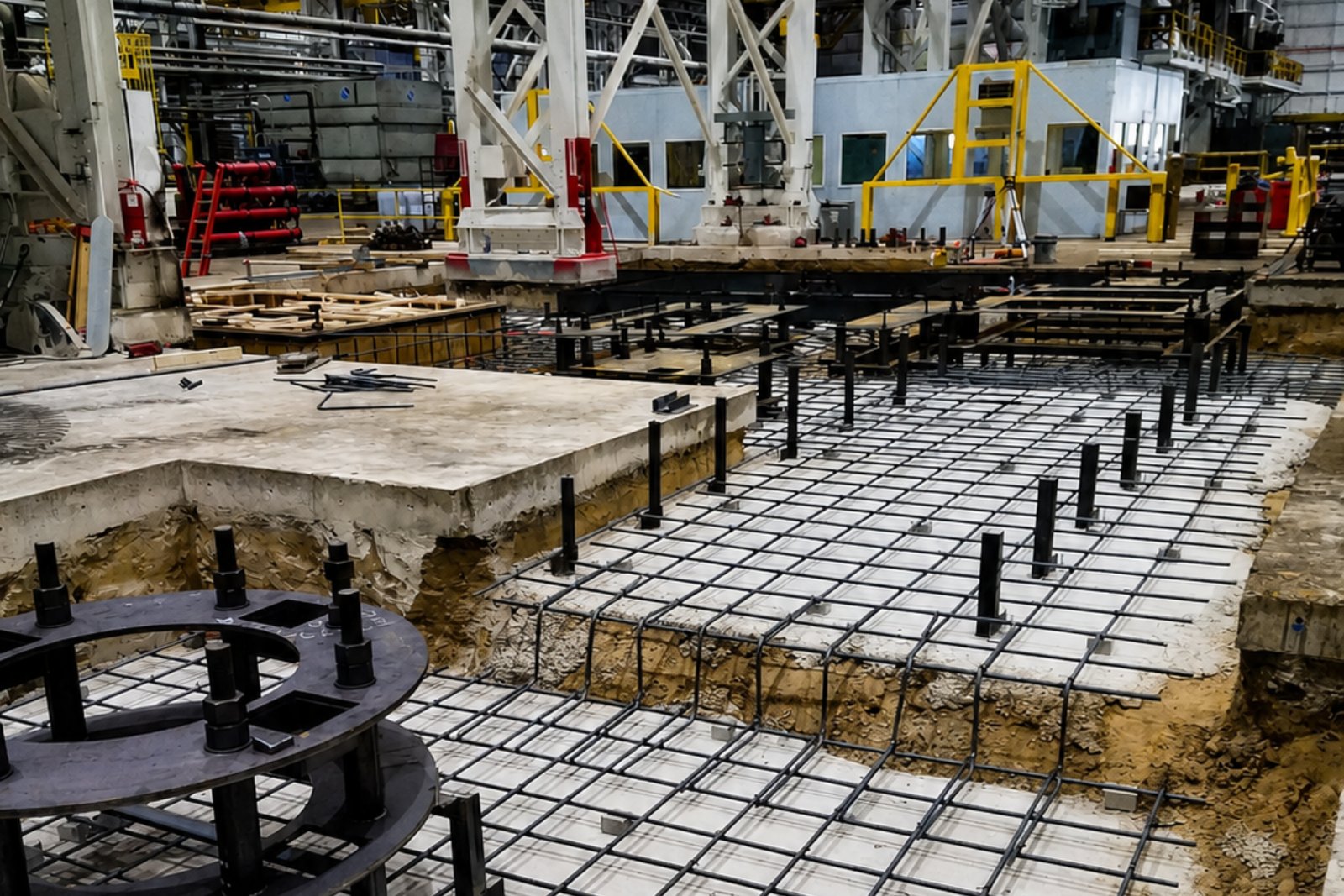
Equipment Pads and Machine Foundations in Las Cruces
The first question on a machine foundation is never how many yards. It is what the machine weighs, how it vibrates, where the bolts go, and how much tolerance the manufacturer allows. We ask for the equipment submittal before we price the pad, because a rooftop chiller on a curb has little in common with a stamping press or a generator set that needs a pad five feet thick.
In Dona Ana County the demand comes from several directions. Industrial tenants bring in production lines, dairies and processors add compressors and tanks, and utility-scale electrical gear needs pads for transformers and switchgear. Each one asks for the same basic thing: a stable, level, well-reinforced mass of concrete that does not rock, settle or crack under the machine.
We pour pads on grade, set anchor bolts with templates, grout baseplates and coordinate conduit stub-ups with the electrical contractor. If the vendor has an installation crew, we agree on who sets what and when so there is no argument about dimensions on the day the machine arrives.
Reading the equipment submittal
A machine foundation starts with three numbers on the vendor drawing: static weight, dynamic load and the allowable differential settlement. Heavy rotating equipment can need a foundation mass several times the machine weight to keep its frequency away from the natural frequency of the soil. We do not design that, but we price and build it, and we raise questions when the dimensions look light for the equipment.
Next come the interfaces. Anchor bolts must land within a tight tolerance, usually a fraction of an inch, and their projection above the pad has to match the baseplate and nut stack. Conduit, drain lines and ground rods often pass through the pad. We build a template, coordinate with the electrical sub, and verify under the 2020 New Mexico Electrical Code, which adopts the 2020 National Electrical Code as amended, that grounding provisions are not buried by a concrete pour.
Building the pad from the subgrade up
Subgrade first. We strip and proof-roll the area, replace soft spots with compacted engineered fill, and confirm density with the testing lab before forming. Heavy machine pads often sit on over-excavated and recompacted material, a process we describe on our over-excavation and recompaction page, because uniform support under the whole footprint matters more than the top surface.
Steel is placed to the engineer's schedule, usually heavier mats at top and bottom with dowels where the pad ties to adjacent slab. Large pads are cast in a single pour whenever possible so there are no cold joints. When the pad is too big for a continuous pour in a day, we plan lifts with surface preparation between them. Curing is long and careful, using wet cover or membrane, because a thick pad gains heat internally and can crack if the surface cools too quickly. See our notes on mass concrete pours for that discussion.
Who asks for machine foundations here
The City of Las Cruces Innovation and Industrial Park sits at the junction of I-10 and I-25 next to Las Cruces International Airport, with more than 400 acres shovel ready and another 500 acres available, and it is covered by Foreign Trade Zone 197. Those are the sites where manufacturers retrofit or build production space. A recent announcement describes a manufacturer renovating an existing 45,050 square foot building on 15 acres there, which is exactly the type of project that needs new equipment pads sawed into an old slab and tied in.
Industrial and manufacturing owners are our most frequent request, followed by utilities and energy companies with substation and generator pads, and agricultural operators with milk cooling and processing gear. We keep an eye on each one's quirks: manufacturers want flatness and vibration control, utilities want grounding and cable routing, and farms want drainage and washdown. Plants that build vehicles belong in the same group, and automotive and EV plants have a page of their own.
Fitting the pad into the equipment delivery
Equipment lead time drives the schedule. The vendor tells you when the machine ships, and the pad has to reach strength before the machine is set. For a standard 4,000 psi mix that is seven days for a light unit and often 28 days for a heavy press, depending on what the manufacturer allows. We back-schedule from the delivery date and tell you plainly when the pour has to happen.
If a plant is already operating, we phase the work around production. Saw cutting, demolition and slab breakout are done in a quiet window, and we plan pump routes and truck traffic so the plant does not stop. We coordinate concrete sawing, cutting and coring for penetrations in existing floors so the new pad can tie in cleanly.
What changes the price
Thickness and reinforcing density change the price more than the footprint does. A 12-inch pad with a single mat is simple. A 4-foot pad with two mats and embedded sleeves is a structural pour that needs forms, shoring on the sides and a pump. Anchor bolt layouts, cast-in sleeves and embedded plates add labor to the form shop and the field.
Access and demolition matter too. Working inside an existing building usually means smaller equipment, hand finishing and haul-off of cut slab, and the cost per yard goes up even though the number of yards goes down. We give an itemized number so you can see where the money is going and what could be simplified.
Have a machine arriving soon?
Send us the vendor drawings and your delivery date. We will respond with a pad plan, a pour schedule and anything that does not look right in the submittal. The concrete foundation trade crews can handle the surrounding building as well.
Questions Owners Ask
Do you design the machine foundation?
No. The foundation design comes from the structural engineer, often with input from the equipment vendor. We build to that design, point out conflicts and propose practical changes through the engineer when something does not fit in the field.
How thick do equipment pads need to be?
It depends on the machine. Light mechanical gear may sit on a 6 to 8 inch pad. Heavy rotating or reciprocating equipment can need several feet of concrete. The vendor and the engineer set the dimension based on weight, vibration and soil capacity.
Can new pads be tied into an existing slab?
Yes. We saw cut the opening, drill and epoxy dowels where the engineer specifies, and pour the new pad against a prepared edge. Isolation joints are used when the machine vibrates, so the vibration does not travel into the existing floor.
What about non-shrink grout under baseplates?
Grout fills the gap between the baseplate and the pad so the load is distributed evenly. We install it to the manufacturer's instructions, with forms to contain it and enough flow to leave no voids. It needs to cure before the machine is run.
How soon can the machine be set after the pour?
That is set by the vendor and the engineer. A common requirement is 75 percent of design strength. We keep cylinders from the pour and give you the break results so the installer can make the call.