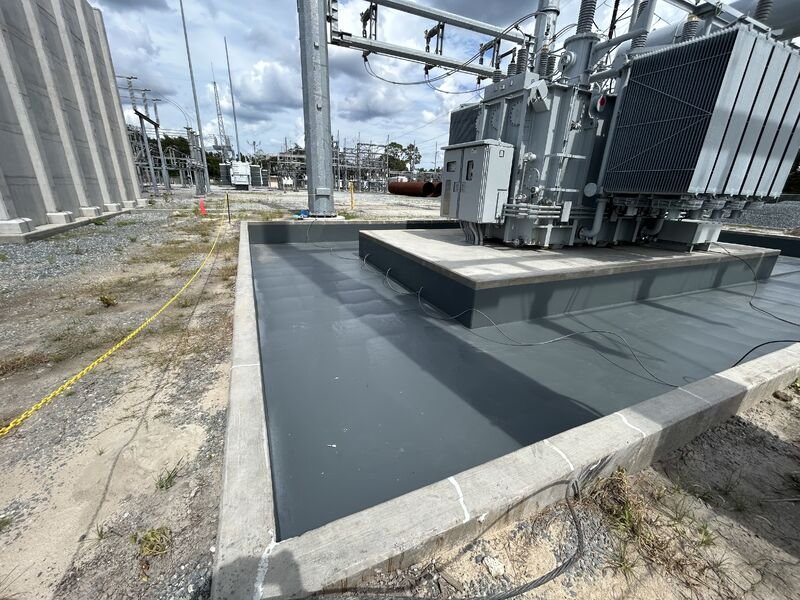
Containment Pads and Secondary Containment in Las Cruces
Rain is rare in the Mesilla Valley, which is exactly why containment pads get designed badly. Las Cruces averages 9.14 inches of precipitation a year, and the surrounding arroyos are described as dry streams that often carry water after heavy thunderstorms. A containment area that sits dry for eleven months can fill in an afternoon, and it needs a plan for that water as well as for the spill it was built to hold.
A containment pad is a concrete floor with a lip, or a floor inside a curbed basin, built so a leak from a tank, a drum rack, a transformer or a fueling island goes nowhere but into a controlled sump. It sounds simple. In practice, the joints, the cracks, the sealant, the slope to the sump and the connection to the equipment pad underneath decide whether it contains anything.
We build containment for fuel storage, chemical totes, lubricants, process tanks at food and beverage plants and utility equipment. We form, reinforce, pour, cut joints, seal and test. We coordinate with the environmental consultant or engineer who sets the required capacity, and we build what the drawings say while pointing out details that will not survive a summer of sun.
What sets the size and the details
The required volume usually comes from the spill prevention plan or the owner's environmental consultant, not from us. A common design target is the largest tank plus an allowance for rain, but the consultant decides. We take that number and translate it into dimensions: floor area, wall height and slope. The concrete mix is chosen for low permeability, with a low water-to-cement ratio and air entrainment where freeze-thaw is a concern.
Commercial buildings and structures in the state are reviewed under the 2021 New Mexico Commercial Building Code, which adopts the 2021 International Building Code as amended, and any concrete structure is subject to that framework. Environmental and fire authorities may have their own requirements for fuel and chemical storage. We ask early who the reviewing authorities are, since a late comment from a fire marshal can change a containment wall height after the forms are built.
How we build a pad that holds liquid
Subgrade prep is the quiet foundation of containment. We proof-roll, replace unsuitable material, and compact the base so the floor does not settle and crack. Reinforcing is designed to keep cracks tight, not to prevent them, so we place the steel at the correct depth and tie it well. Waterstops go into construction joints between floor and wall, and the joint is formed to give the sealant a clean, regular face.
We cut or form control joints at the engineer's spacing and seal them with a chemical-resistant sealant after the concrete has dried enough to let the sealant bond. Surfaces get a broom or light trowel finish that sheds liquid toward the sump. Sumps are formed in the slab, with a drain valve or a manual pump-out arrangement, and the slope is checked with a level before the pour is closed.
Storms, ditches and the water that gets in
Monsoon storms can drop heavy rain on a containment area within minutes, and an uncovered pad will fill. The owner needs a way to remove stormwater without releasing contaminated water, which usually means a sump with a manual valve kept closed until the water is inspected. Roofing over the pad is an option, and so is a rain-diverting curb around the perimeter. We help owners work through those choices before the pour, since adding a roof or a curb later costs more.
Irrigation also matters. Farm irrigation around Hatch uses wells and surface water from irrigation ditches that divert water from the Rio Grande, and in the farm country of the valley a fuel or fertilizer containment pad may sit close to a ditch bank. The same is true of industrial sites near drainage channels. That makes the integrity of the containment more important, and we pay attention to ditch locations and flow when we choose the site grading and drainage around the pad.
Working around hazardous material
Existing containment areas are sometimes contaminated, and we take that seriously. Before we cut, break or core any old pad, we ask the owner for the site safety plan, any known releases and the required PPE. Concrete that has soaked up fuel or solvents has to be handled and disposed of according to its contamination, not hauled as clean rubble. We coordinate with the owner's environmental contractor in those cases.
New construction has its own safety focus: silica control during saw cutting, ventilation when sealants are applied in a confined basin, and traffic control when we are working at an active fueling or loading area. We hold a daily safety meeting and review the specific hazards on that day's task.
Testing and handoff
On many projects the owner wants proof that the containment holds. A flood test fills the basin with water to a set depth and measures the drop over 24 to 72 hours, adjusted for evaporation. We build the pad so the test can be done before equipment is installed, and we schedule the test with the owner's representative. If the test fails, we trace the leak, repair the joint or crack and test again.
We also give the owner a short maintenance note covering sealant inspection, crack watching and drain procedures. Sealants age in sunlight, and a seal that was fine at handoff can fail in five years if no one looks at it. That small note often prevents a large cleanup.
Where containment meets other scopes
Containment seldom stands alone. It sits next to equipment pads and machine foundations, inside truck loading areas and near trench drains and concrete drainage that route clean stormwater away. At rail-served yards, such as the 1,100-acre Santa Teresa Gateway Rail Park served by the Santa Teresa Southern Railroad, bulk transfer areas may need their own containment pads next to unloading tracks.
Oil, gas and midstream clients and utilities and energy companies are the owners who most often need secondary containment, and we are happy to talk with them early so the footprint and the drainage match their permit documents.
Planning a containment pad?
Tell us what you store, how much, and where the water will go in a storm. We will respond with a pad layout, joint plan and test procedure. If your site also needs drainage, we can pair the work with a storm drain installation scope.
Questions Owners Ask
How big does the containment need to be?
That is decided by the engineer or environmental consultant, usually from the size of the largest container plus a rain allowance. We build to that volume and verify it by measuring the finished basin before the owner accepts it.
Should the pad be coated or sealed?
Often yes. Chemical-resistant coatings or sealed joints protect against specific liquids. The choice depends on what is being stored, so we ask for a material list before we recommend a product. Concrete alone is porous.
What happens to rainwater in a containment area?
It collects until someone removes it. Most designs use a sump and a valve that stays closed, so water can be inspected before release. A roof or a curb cap can cut the volume, and we can discuss which is more practical.
Can you add containment to an existing tank farm?
Usually, though it takes planning. We may need to work around existing tanks, pipe supports and utilities, and the tanks may need to be moved or emptied. We prepare a phasing plan that limits the downtime for the owner.