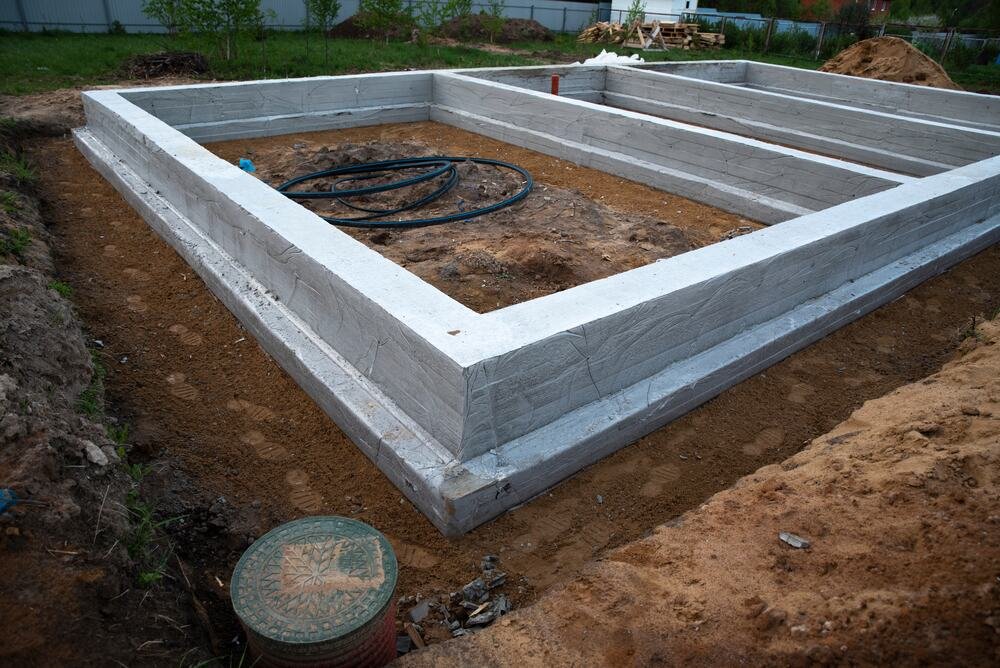
Grade Beams for Commercial Buildings in the Mesilla Valley
Between every pair of piers or footing pads there is a span of soil that nobody wants to rely on, and the grade beam is what crosses it. It carries wall loads from a tilt panel or a block wall to the piers, ties the foundation into a single unit, and keeps the building edge from moving if the ground under it softens after a wet season. We build them with the same care as any structural member, because that is what they are.
Where the soil can swell or shrink, we often form the beam with a void under it so the soil can move without lifting the structure. Where the beam is simply a deep, narrow footing between spread pads, we dig a clean trench, set the cage on chairs and pour it monolithically with the slab edge if the drawings allow. The geotechnical report and the structural engineer decide which approach fits, and our job is to build to the drawings and tell you early when the site and the drawings disagree.
Most of our grade beam work supports tilt-up warehouses, light industrial buildings and equipment enclosures, where long wall lines meet widely spaced piers. If you are comparing a pier-and-beam system with a conventional footing, we are glad to walk through the trade-offs on your actual layout.
How we sequence a grade beam run
We start from survey control. The beam line, the top-of-concrete elevation and the pier tops all get checked with a level before anyone cuts steel. Pier tops are chipped to sound concrete, and their dowels are verified against the schedule. Next we excavate the beam trench to the plan dimension, trimming the sides by hand where the machine leaves a rough face and verifying that the bottom is firm, level and free of loose soil.
Then the steel goes in: bottom bars, top bars, stirrups and any extra bars at the piers. If a void form is called for, we set it on a grade-matched bed and brace it so it cannot float during the pour. The forms go up, the inspector walks the work, and we place concrete with a pump or a chute depending on access. A good grade beam pour is boring: continuous, vibrated at the stirrup spacing, and screeded flush at the top so the next trade does not have to shim.
What is in our scope
The scope includes excavation of the beam trench, formwork where the sides do not stand open, reinforcing, void forms, embeds and dowels for walls and columns, concrete placement and curing. We also handle backfill against the finished beam once the strength requirement is met, using compaction in lifts so the soil next to the beam does not settle and pull the slab edge down with it.
Some projects tie the beam into a thickened slab edge. Others use a stand-alone beam with an isolated slab inside. We price each condition separately because the formwork, the joint detail and the pump time differ. Where drilled shafts support the beam, our drilled pier foundations work and the beam scope often run in the same mobilization, which saves the project a pump setup.
Why we manage the dirt, steel and concrete together
A beam fails in the handoffs. The earthwork contractor leaves the trench a little deep, the rebar sub spaces stirrups loosely, the forms are patched in the field, and the concrete arrives to a trench that has been sitting open through a thunderstorm. When one team controls the sequence, those mistakes get caught the same day. We coordinate the digging, forming, steel placement and pour, and we use the experience of each step to anticipate the next one.
That also lets us adjust to field conditions. If the trench bottom turns soft, we have equipment on site to undercut and replace with compacted fill or a lean mix. If the layout shifts a foot to fit a utility, we reroute the beam and re-check the cage. You can read more about how we handle subgrade problems under over-excavation and recompaction.
Where we run grade beams in the metro
The communities along the river and the interstate each present something different. Vado lies on the east bank of the Rio Grande in the Mesilla Valley, and valley floor soils there call for careful inspection of trench bottoms after irrigation season. Chaparral, with a 2020 census population of 16,551, lies on the east side of the Franklin Mountains and is geographically isolated from the rest of Dona Ana County, so we plan deliveries and crew travel with that distance in mind. Our Vado and Chaparral pages cover those areas in detail.
State Road 28 passes through the Mesilla Valley agricultural communities of La Union, Anthony and Vado, and the farm and dairy buildings along that corridor are where simple grade beams under steel framing or masonry walls show up most often. We serve agriculture and dairy owners who need foundations that tolerate wet ground near irrigation ditches and heavy equipment traffic.
Permits, inspection and testing
Grade beams on commercial projects fall under the structural provisions of the 2021 New Mexico Commercial Building Code, which adopts the 2021 International Building Code as amended and took effect July 14, 2023. The inspector looks at the trench before steel, at the steel before concrete, and at the concrete cylinders afterward. We call for each step, and we do not pour until the signature is on the card.
We also coordinate cylinder breaks with the lab and keep the break results in the project file. If the beam is cast with a mix that needs a hot-weather or cold-weather plan, we write that plan before the pour, not on the day. See our notes on rebar placement for how we handle cover, splices and tie spacing.
Planning a pier-and-beam foundation?
Send us the foundation plan and the soils report. We will confirm the trench conditions, the void form detail and the pour sequence, and tell you where we would adjust to save time. For the larger picture of building foundations, see our work on footings and stem walls.
Questions Owners Ask
What is the difference between a grade beam and a footing?
A footing sits on soil and spreads load into it. A grade beam spans between supports, such as piers, and carries load horizontally to them. Many buildings use both: spread footings in good soil and grade beams between piers where the soil is weak or expansive.
Do grade beams need void forms?
Only when the geotechnical report calls for them, usually in soils that swell with moisture. The void gives the soil room to rise without lifting the beam. We install void forms to the manufacturer's instructions and keep them dry until the concrete is placed.
How long before we can backfill a beam?
The engineer sets the required strength. In most cases we wait until cylinders show enough strength and the forms have been stripped, then backfill in lifts, compacting each one. Backfilling too early can bow a beam or crack the cover.
Can grade beams be poured with the slab?
Sometimes. A monolithic pour saves a cold joint and some labor, but it needs the beam formed and reinforced at the same time as the slab, and a pump that can reach. We evaluate that case by case, along with the finishing tolerance on the slab.