Concrete Pumping and Placement in Las Cruces and the Mesilla Valley
A concrete pour is mostly a logistics problem with a chemistry problem hiding inside it. Before we talk about the pump, we want three numbers from you: the yardage, the time the first truck can reach the gate, and the hour the last bit of the slab has to be finished. Once those are on the table, choosing between a boom pump, a line pump or a conveyor stops being a matter of taste and becomes arithmetic.
Around Las Cruces the arithmetic has a thumb on the scale. The city averages 9.14 inches of precipitation a year, summer highs in June average 96.2 degrees F, and spring afternoons can bring wind and blowing dust. None of that is dramatic, but all of it changes what happens to a wet slab between the discharge hose and the finishing crew. A pour that starts at dawn is a different pour from one that starts at ten.
We plan placement as one operation: truck spacing, pump position, line length, who is standing where with a vibrator, and how fast the finishers can follow. That is the thinking behind every pour we schedule in the metro.
Setting the pour window and truck cadence
Start with the batch plant and work forward. Concrete in the Mesilla Valley spends its first hour in heat, so we agree on a truck cadence with the supplier that keeps the pump fed without letting loads queue in the sun. A steady stream of trucks, one every few minutes on a large placement, is better than a bunch of trucks arriving together and then a gap. We confirm the route in, the turning room at the pump, and where washout goes before the first ticket is printed.
Our usual answer to summer is to move the placement earlier. Starting at first light puts most of the finishing before the afternoon peak, and we set slump, retarder and the curing plan with the engineer and the mix supplier ahead of time rather than adjusting on the fly. For flat slabs, our page on hot and windy weather concrete goes deeper on evaporation control, fogging and curing compound timing.
What we pump and place
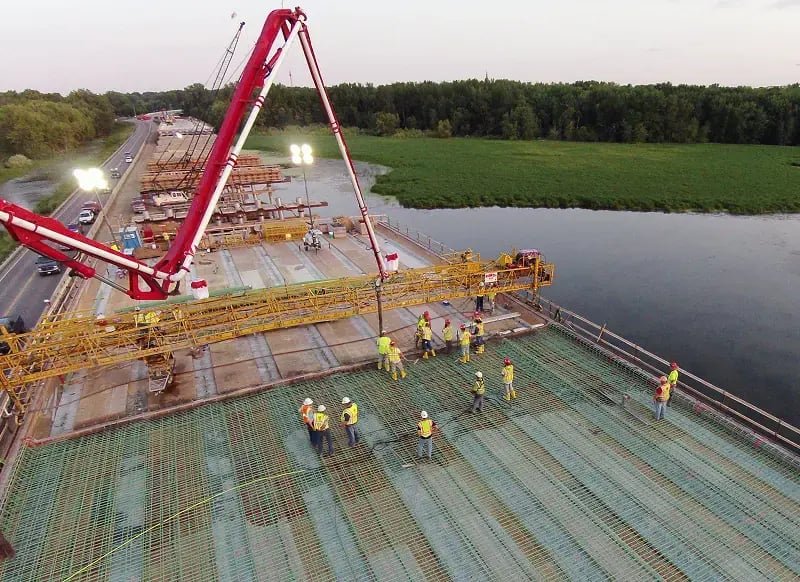
Pumping is how we get concrete to places a chute cannot reach: interior bays behind finished walls, deep footings, drilled piers, the far side of a long building and elevated work. On big floor placements, the pump lets us keep trucks on the perimeter and avoid driving across fresh rebar or vapor barrier. We place slab on grade work, grade beams, stem walls, equipment pads, dock pits and, when the structure calls for it, elevated slabs and decks where the pump line carries the load up and over.
Mix design drives pumpability. A mix that is perfect on paper but stiff in the line will plug a pump and cost the whole crew an hour, so we talk with the supplier about aggregate size, admixtures and slump at the pump rather than only at the truck. If the engineer wants a lower slump for floor flatness, we adjust line size and pump pressure instead of adding water at the hose.
How a placement crew actually runs
A pump day has a clear order. Subgrade and forms are inspected the day before, the rebar crew is out, and a pre-pour walk with the superintendent covers pump location, outriggers, overhead lines and the route a truck takes if one backs up. Sample cylinders and slump checks are coordinated with the testing agency; our notes on concrete testing and quality control explain how that works from the field side.
During the pour one person owns the hose and one person owns the radio. The finishing crew sets screed rails or laser screeds as the placement moves, and we watch the discharge for segregation or stiffening. If a load is rejected, the replacement is already on its way because we staged the next truck before the first one finished unloading.
What changes the price of a pump day
Pump pricing follows equipment size, minimum hours, line length and the number of moves. A single tidy placement with a boom truck is less expensive per yard than three small placements spread across a week, because each setup, wash-out and travel leg has a cost. We will often suggest combining pours when the sequence allows it, and splitting them when joints are better placed in a different location.
Access is the quiet cost driver. Overhead utility lines, soft ground under outriggers, narrow gates and a lack of washout room can force a longer boom or a longer line, and each of those moves the bill. We walk the site early and tell you about it before it shows up on an invoice. On logistics projects in the Santa Teresa area, where speculative warehouses of 365,000 and 135,000 square feet have been built, the same principle holds at larger scale: a good truck route is worth more than a faster pump, which is why we settle it early with logistics and warehouse developers.
Working safely around the boom and the line
Pump booms and lines carry pressure and weight. We set outriggers on prepared ground or mats, keep a clear zone beneath the boom, and require everyone near the hose to understand the stop signal. Overhead electrical lines are located and flagged before the truck is positioned, and we do not extend a boom near an energized line unless the utility owner has dealt with it.
Washout is part of safety and part of keeping a permit in good standing. We plan a washout location that does not drain into a storm inlet, an irrigation ditch or an arroyo, and we clean up before the trucks leave. We wear the right protection for cement burns and silica, and we put a trained person on every placement.
Tell us the yardage and the date
Send us your quantity, your target pour day and the location, and we will come back with a pump recommendation, a truck plan and a weather window. If your project is a warehouse floor or a data center pad, say so, since those drive different line layouts. Call or write and we will start the plan together.
Questions Owners Ask
How far ahead should we book a pump for a large slab in Las Cruces?
For a big floor placement, we want the pump on the calendar as soon as the pour date is firm, not when the forms go up. Large placements often need more than one pump or a backup, and suppliers also have to line up trucks and a plant schedule. Summer mornings fill first, so earlier notice gives us the best pour window. We will confirm the quantity and the cadence in writing before the day.
Can a line pump handle a stiff mix for a flatwork slab?
Often, but it depends on the mix. Pumping a lower-slump mix takes a properly sized line, the right aggregate gradation and a pump with enough pressure. We work with the supplier and the engineer to set the slump at the point of discharge, then adjust equipment instead of adding water on site, which would hurt strength and shrinkage.
What if the pump cannot reach the far side of a tilt-up or large building footprint?
We lay out pump positions before the walls are up. A boom pump can reach a surprising distance, but a long building usually means moving the pump partway through or running a line through a door opening. Planning pour strips with that in mind keeps joints where the engineer wants them. Our work on tilt-up concrete panels follows the same approach.
Who handles the testing during a pump pour?
A third-party testing agency typically samples the concrete, checks slump and air and casts cylinders, and we coordinate access, shade and curing boxes for those samples. We also keep our own slump checks so we spot a drifting load before the agency does. If a load fails, we reject it and tell the supplier right away.
Does wind or heat ever stop a pour?
It can delay one. High wind and heat raise evaporation and can make finishing hard, and we reschedule if conditions are outside what the mix and the curing plan can handle. More often we shift the start earlier or add evaporation retarder, fogging and wind screens. The decision is made with the engineer and the supplier, not on the fly.