Concrete Demolition and Removal in Las Cruces
An old mall, a worn-out industrial slab and a worn-out parking lot all end the same way: someone has to break the concrete, load it and drive it away without damaging whatever is staying. Mesilla Valley Mall opened in 1981 with 602,150 square feet on 77.4 acres and 4,500 parking spaces, and the scale of that single site gives a sense of how much concrete a commercial property can hold. Demolition is the first step of most redevelopment, especially for retail shopping centers, and it sets the tone for the rest of the job.
We take out slabs on grade, footings, foundations, walls, curbs, sidewalks, pavements and equipment pads. We saw cut where a clean line matters, break with hydraulic hammers and crushers, sort the rebar from the concrete, and haul or recycle what leaves the site. We also protect what stays, including utilities, adjoining slabs, trees and neighboring buildings.
Developers, general contractors and owners call us when a site is about to change. A building renovation, a lot conversion or a new pad on an old site all begin with a conversation about what is under the surface and what has to come out.
How we take concrete out
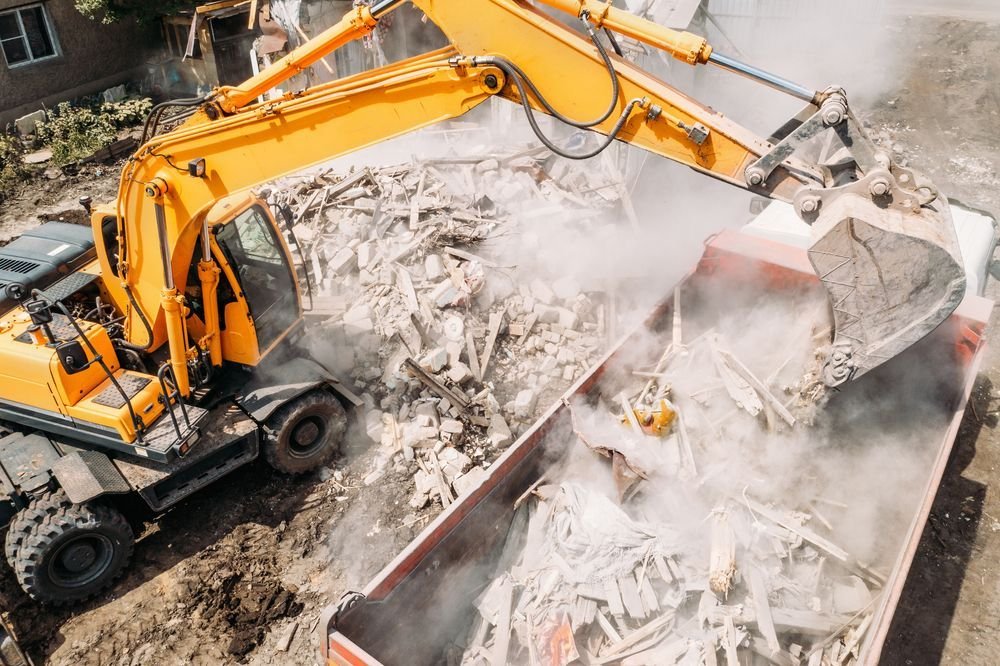
Planning starts with the survey: thickness, reinforcement, joints, what is under the slab and what is next to it. We probe or core to find out whether the slab is plain, mesh-reinforced or heavily barred, and whether it sits on sand, gravel or native soil. We locate utilities and mark them, then decide the method. Saw cutting along the limit of removal protects adjacent concrete from spalling. Breaking is done with excavator-mounted hammers on large areas and hand tools in tight spaces. Pieces are loaded into trucks for recycling or disposal.
Removal of foundations and footings is more involved. We expose them, cut them into sections and lift or break them in place. Rebar is separated, bundled and sent to a scrap recycler. Voids left by the work are backfilled and compacted to the specified density so the next stage of construction starts on solid ground, whether that is a slab on grade or a new foundation. We coordinate over-excavation and recompaction as part of the same mobilization.
Permits, classifications and who needs to sign off
Demolition of buildings and structures falls within the general building classification in New Mexico: under 14.6.6 NMAC, the GB-98 General Building classification covers erecting, altering, repairing or demolishing residential and commercial buildings and certain structures. That is relevant when you hire a contractor for building demolition, and it is a good question to put to any firm you consider. For flatwork-only removal, requirements are different, and we ask the local permitting office and the owner's design team what applies.
Beyond the contractor license, a demolition job may involve a demolition permit, a dust control plan, utility disconnect letters and notification to neighbors. Old buildings may contain asbestos or lead paint, which must be surveyed and handled by a qualified abatement contractor before demolition begins. We do not start until the owner confirms that the survey is complete.
Dust, noise and what falls
Breaking concrete makes dust, noise and vibration. We control dust with water spray and, for interior work, with vacuum systems and containment. Noise limits and work hours are set with the local authority and the owner, and we keep to them. Vibration near other structures is monitored when the engineer asks for it, and we adjust the method to keep it in range.
The big risk is unplanned collapse or kickback. We never undercut slabs we are standing on, we keep operators clear of falling pieces, and we brace partially removed sections. Suspended slabs and walls are cut and removed in a planned sequence, with shoring where required. Every worker on the site knows the exclusion zones before the first hammer swings.
Sequencing the removal
The best demolition schedule fits the construction schedule that follows. A manufacturer renovating an existing 45,050 square foot building on 15 acres at the Las Cruces Innovation and Industrial site is a good example of a project where portions of an existing building are removed and kept at the same time. Demolition crews work in zones, opening the area the next trade needs while leaving the rest of the building operational. We map those zones with the project team and update them as the work progresses.
Haul routes and disposal sites shape the daily pace. A truck cycle of a few hours means we can only load so many trucks per day. We stage stockpiles for crushing or sorting if the site allows it, and we choose haul routes that keep trucks off residential streets. See our import, export and haul-off page for how we manage loads and disposal.
Where we take concrete out
Our removal work covers the metro, from the city of Las Cruces to the border communities. Typical jobs include old parking fields in retail centers like the Mesilla Valley Mall area, aging industrial slabs, abandoned equipment pads and aprons at airports and small industrial parks. Because Las Cruces is the southern terminus of Interstate 25, where it meets Interstate 10, trucking is straightforward once the load is on the highway.
Recycled concrete often goes back to the same project as base material when a crusher is on site. Where it cannot, we find a nearby recycler or approved disposal location. General contractors and construction managers ask us for a clear tally of tons removed, haul tickets and photographs, and we provide them as part of closeout. Owners clearing a whole lot, not a single slab, can read about our demolition and site prep scope.
Have concrete to remove?
Send us the area, a photo of what is there and your target date. We will confirm what is under the surface, quote the removal and give you a haul plan. If the next step is new construction, the concrete foundation trade crews can follow right behind.
Questions Owners Ask
Do you recycle the concrete you remove?
Whenever possible. Clean concrete can be crushed and reused as base or fill, either on the same project or at a recycler. Rebar is separated and sold for scrap. We document where the material goes so the owner has a record.
How thick is the slab I need to remove?
We find out. A core sample or a saw cut shows the thickness and any reinforcement, and a short test dig shows the base. Thickness drives the method, the equipment and the haul tonnage, so we measure before we bid.
Can you demolish a slab next to an operating building?
Yes, with controls. We saw cut the limit of removal, use smaller equipment and monitor vibration and dust. Where the adjoining building is sensitive, we may use hand breakers or wire sawing, and we adjust work hours to the occupants' needs.
Who handles asbestos or lead paint?
A licensed abatement contractor, not us. If the building may contain either, a survey should happen before the demolition, and abatement should be complete before we start. We will ask for the survey results and the abatement clearance.
How long does demolition take?
It depends on the area, thickness and access. A parking lot can be cleared in days. A building with foundations and interior slabs takes longer. We provide a schedule after seeing the plans and visiting the site.