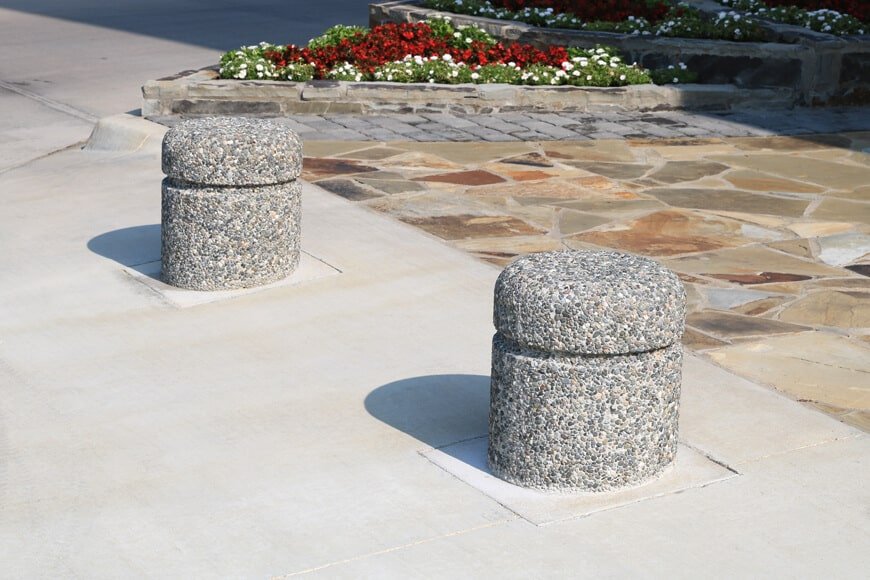
Bollards and Site Concrete in Las Cruces and Dona Ana County
Bollards look like the simplest thing on a site: a steel pipe in a hole with some concrete. They are also the thing a delivery truck hits most often. A bollard that was set too shallow, too close to a buried line or with the wrong mix is a bollard that leans after the first impact. We treat each one as a small foundation, because that is exactly what it is.
Around the bollards sits the rest of the site concrete: light pole bases, sign foundations, dumpster enclosures and pads, wheel stops, trash pad aprons, equipment curbs, transformer pads, fuel island slabs and similar details. None of them individually is large. Collectively they take a surprising share of a project's closeout list.
We handle those items for general contractors and owners who want one team to finish the details properly. If a site package includes bollards, pole bases and pads, we plan them together so they get laid out, dug, poured and finished in a single visit.
What we set and pour
Bollards: we mark locations from the plan, locate underground lines and drill or dig holes to the specified depth and diameter, typically two to four feet deep depending on the application. The pipe is set plumb in the hole, braced and filled with concrete, then topped with a domed cap that sheds water. Pipe is filled with concrete and, when specified, reinforcing. Removable bollards use a sleeve cast into the concrete with a locking cap.
Pole bases are larger, deeper and need anchor bolts set to a template in exact position. Dumpster pads are reinforced slabs sized for the truck that picks up the bin. Wheel stops are cast in place or doweled precast units. Transformer and generator pads are tied to the electrical contractor's conduits and ground rods. Each item has its own detail and tolerance, and we check the plan before we dig.
Underground first, concrete second
The biggest risk with small concrete elements is hitting something. Irrigation lines, water services, communications conduits and power cables run close to the surface on commercial sites. Before we dig, we call for utility locates, review the utility plan and, near critical lines, pothole by hand or with vacuum excavation. A bollard hole that nicks a fiber line costs far more than the bollard.
The second risk is location creep. Bollards protect storefronts, gas meters, electrical gear and pedestrian paths, so their spacing and offset matter. Too far apart and a vehicle slips between them. Too close and a person in a wheelchair cannot pass, which brings our work back to ADA ramps and accessible routes. We stake the layout, have the superintendent or designer approve it and then dig.
Impact, traffic and the site around it
Vehicle-impact bollards are engineered. The depth, diameter, reinforcing and mix are set by the designer based on the expected impact. We follow those details exactly. If a field condition forces a change, such as a utility in the footprint, we stop and ask. We never shorten a hole or swap a pipe without engineer approval. A bollard rated for a forklift is not rated for a delivery truck.
During construction, we keep traffic away from open holes, barricade fresh concrete and set cones or fencing around pours. Concrete trucks and drill rigs share lots with customers and delivery drivers, so we work in sections and open areas back up as soon as they are safe. We wear high visibility clothing and watch for backing vehicles.
Properties that need site concrete
Retail centers rely on bollards at storefronts, pole bases for parking lot lights and pads for trash enclosures. Mesilla Valley Mall, which lists 85 stores on 77.4 acres, is a reminder of how much pole base, curb and wheel stop work a large retail property carries. See our page on retail shopping centers for the full scope. Industrial properties need bollards at dock doors, pads for compressors and trash compactors, and protection for utility gear.
Border and public facilities add security needs. The Santa Teresa airport was reported to be receiving new hangars and a cargo-only runway, and $500,000 in federal funds were allocated to upgrade the Santa Teresa Port of Entry, a reminder that fences, barriers and bollards are often part of public and transport projects. Our government and municipal clients ask for hardened barriers around entrances, mechanical rooms and utility yards.
Doing it right the first time
We prefer to group small concrete items by trade and by location. All bollards in one area are drilled in one visit, then filled in order. Pole bases are poured with templates and left to cure before electricians set poles. Pads for dumpsters and equipment are poured with the flatwork around them to avoid cold joints.
Finishing matters. Bollard caps are domed and troweled smooth so they drain. Pole bases are crowned so water leaves the bolt circle. Pads get broom finish and edge tooling. We paint or sleeve bollards when specified and coordinate with the painter on color. When the work is done, we walk the site with the owner and fix anything that does not look right.
Across the metro
We set bollards and site concrete from the city to the border communities, including airport sites such as Las Cruces International Airport, where five miles of eight-foot perimeter fence were completed in October 2020 and the airport reported 40 box hangars and about a dozen T-hangars. Fenced, secured aviation sites rely on gate pads, post footings and barriers, the same small concrete items we handle.
Downtown Las Cruces has its own flavor. Historic Main Street, with a pedestrian mall that began in 1973, calls for bollards that fit the streetscape and protect outdoor dining and market areas. We coordinate with the city and downtown groups about layout. Commercial developers and municipal and public works teams use us for that detail work.
Closeout list growing?
Send us the plan sheets for bollards, pole bases and pads and we will price them as a single package. We can also take on the slabs around them with the slab on grade trade crews.
Questions Owners Ask
How deep should a bollard be set?
The design sets it. Typical protective bollards are set two to four feet deep in a concrete footing larger than the pipe, and impact-rated bollards go deeper with more steel. We build to the drawing and the manufacturer's detail.
Do bollards have to be filled with concrete?
Most protective bollards are steel pipe filled with concrete, which adds mass and strength. Decorative or removable bollards may be hollow or use a sleeve.
Can you install bollards in an existing slab?
Yes. We core or saw cut the slab, excavate the footing, set the pipe, pour concrete and patch the surface. We locate utilities first and plan the sequence to keep the area usable.
How long before a pole base can take a pole?
The electrician or pole supplier sets the requirement. Many specs allow setting after seven days, or earlier if cylinders reach the specified strength. We keep cylinders and report the breaks.
Who is responsible for locating utilities?
Everyone on the job. The designer shows what is known, the owner may provide records and we call for locates before digging. We pothole near lines and stop if something unexpected appears.